| Heavyweight Mikado |
Mysteries become obvious
There is a special satisfaction in watching a mystery become obvious.
Monday 19 October
We had a slow morning. Somehow, it was challenging to get out into the forest to continue harvesting the logs we had prepared. DW did not feel well after yesterday's session in the forest; we hypothesized she may have breathed in the tractor's exhaust. I suggested we keep an eye on the wind and have her stand so the smoke doesn't blow toward her.
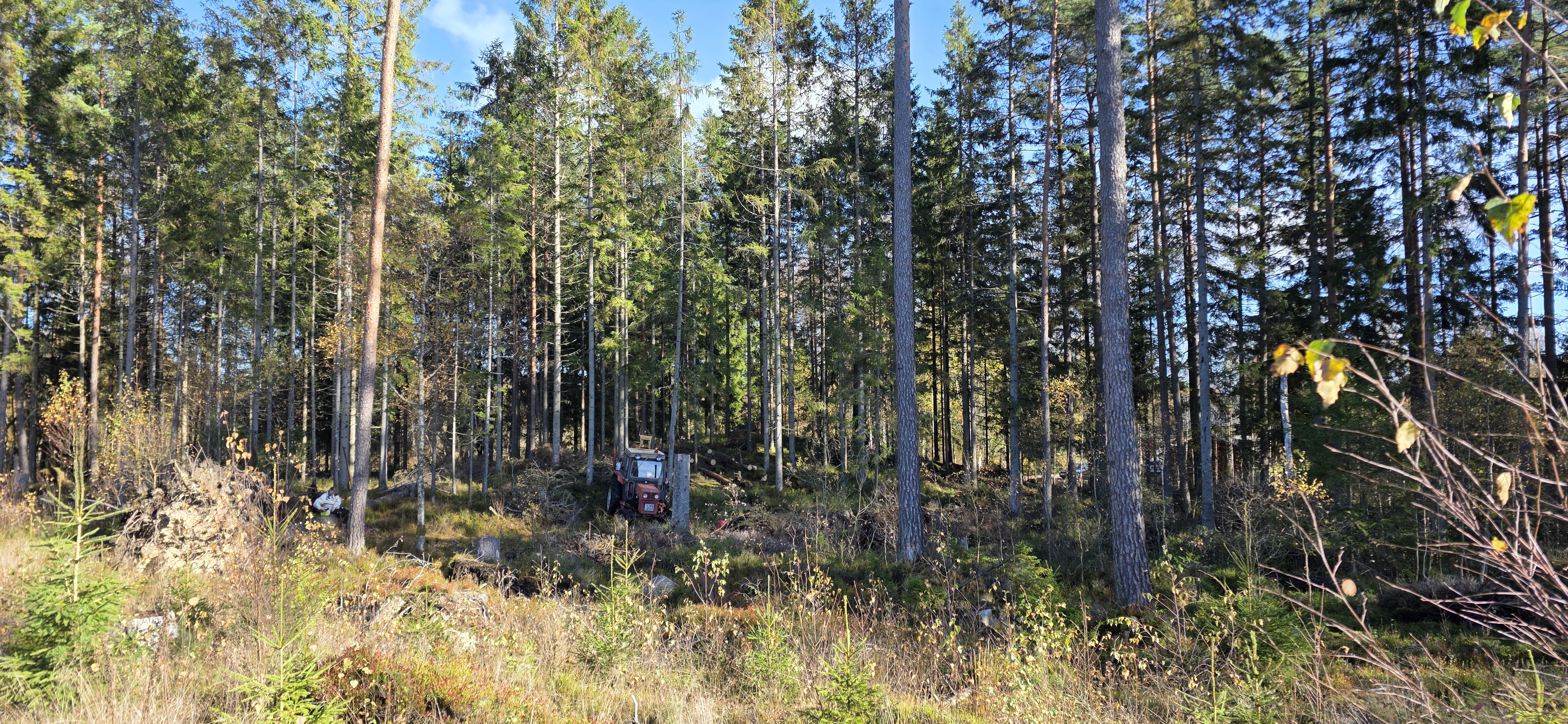 Since we were moving slowly in the morning, we decided to bring sandwiches and tea for a break in the forest.
We headed into the forest and maneuvered the tractor and wagon to harvest the logs from the top of the hill. It was tricky to position the wagon correctly because stones and stumps limited where I could drive. The logs here are about 30-40 years old. I didn't count the rings, but this is my estimate.
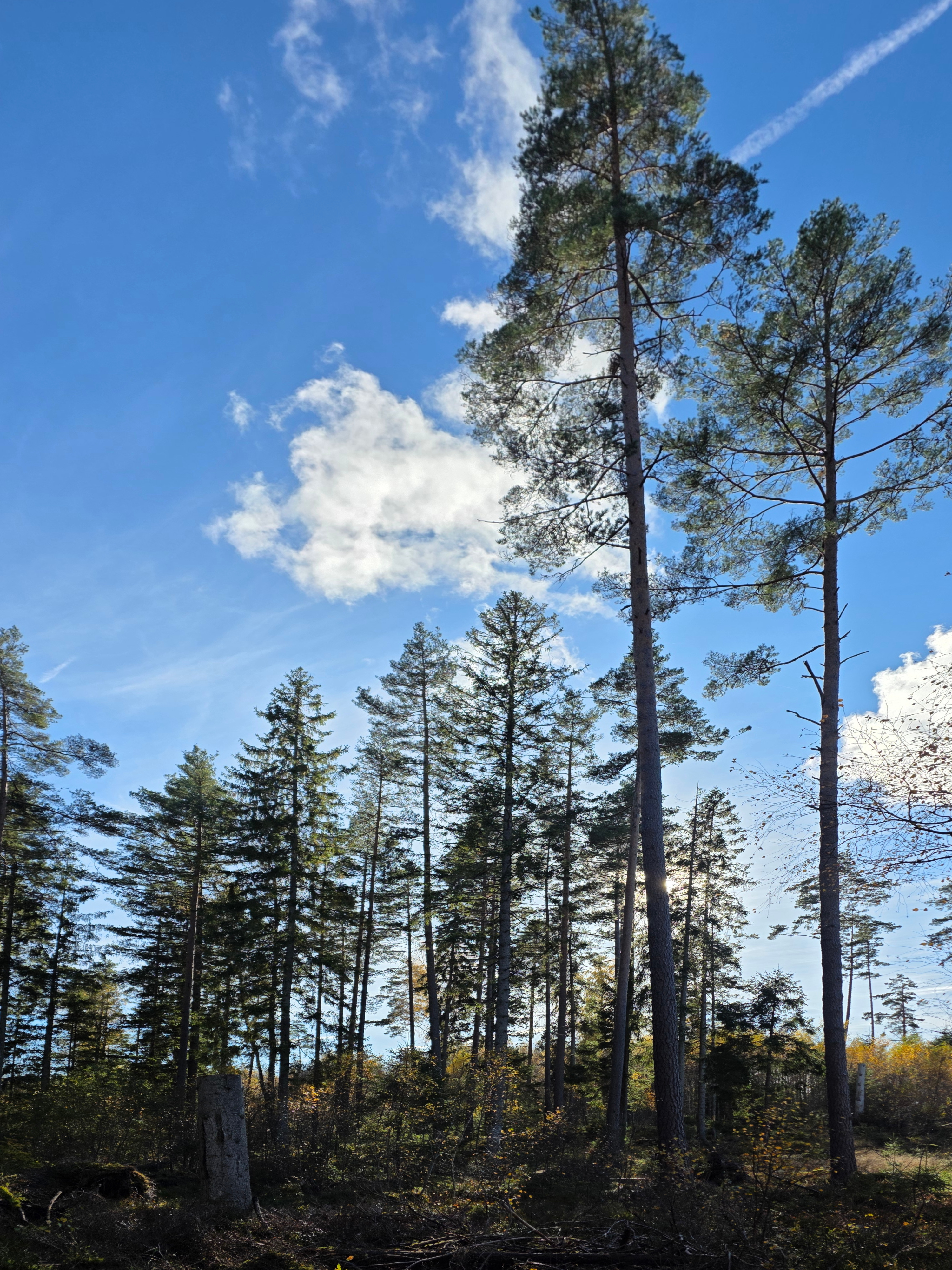 DW stayed away from the diesel exhaust. The sun shone; it was calm, and the temperature was just right for me to put the wire on the logs and guide them onto the wagon. DW stood still most of the time, so she had more clothing on and a hat she had made.
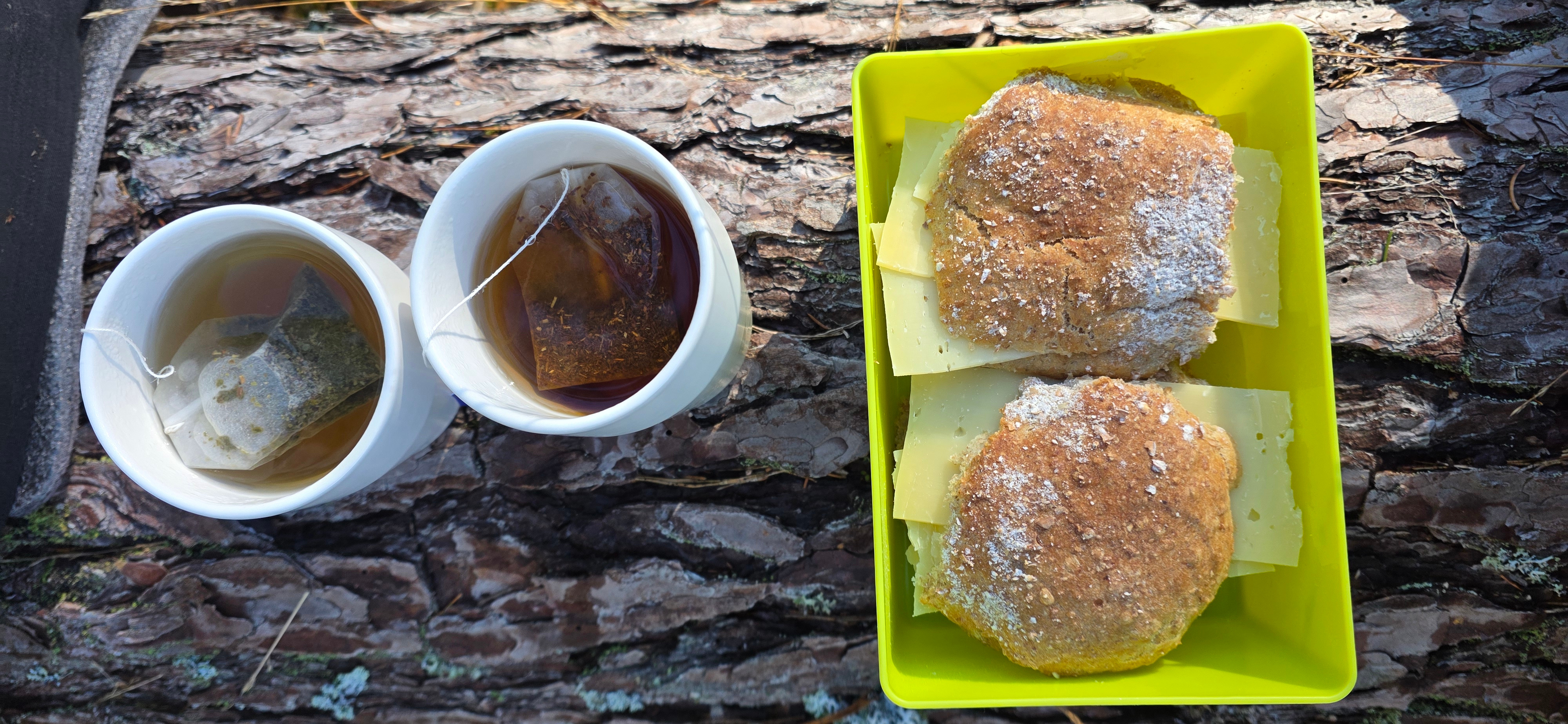 It was such a nice idea to take a break in the forest with homemade cheese sandwiches and tea. We sat on one of the largest trees still lying there, one that still needs to be cut into pieces, and it made a nice picnic tree.
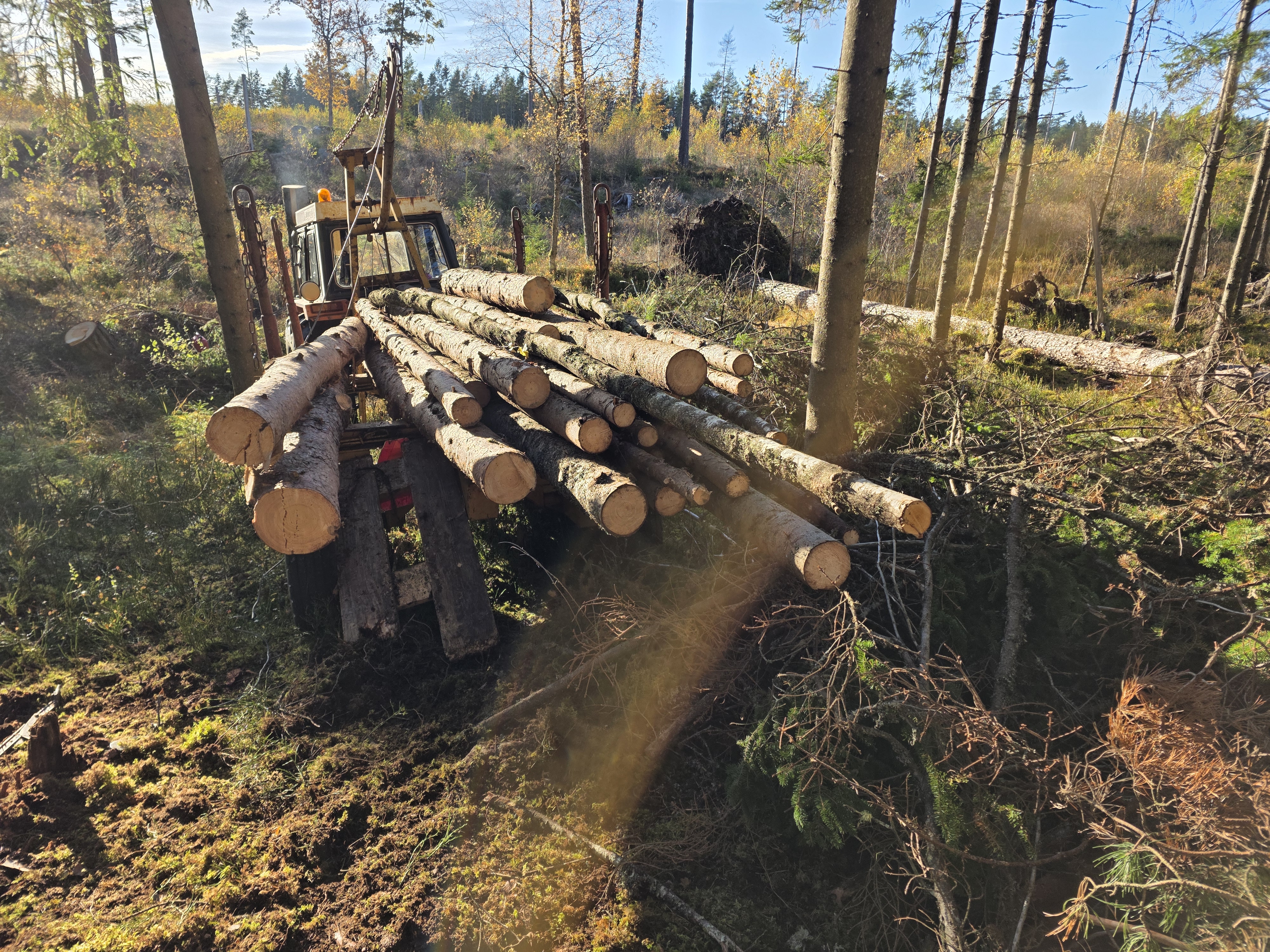 We continued well into the afternoon. About an hour before sunset, we finished picking up all the logs we could reach from that location. Instead of relocating and picking up the final 7 logs, we went home. I had a sore knee.
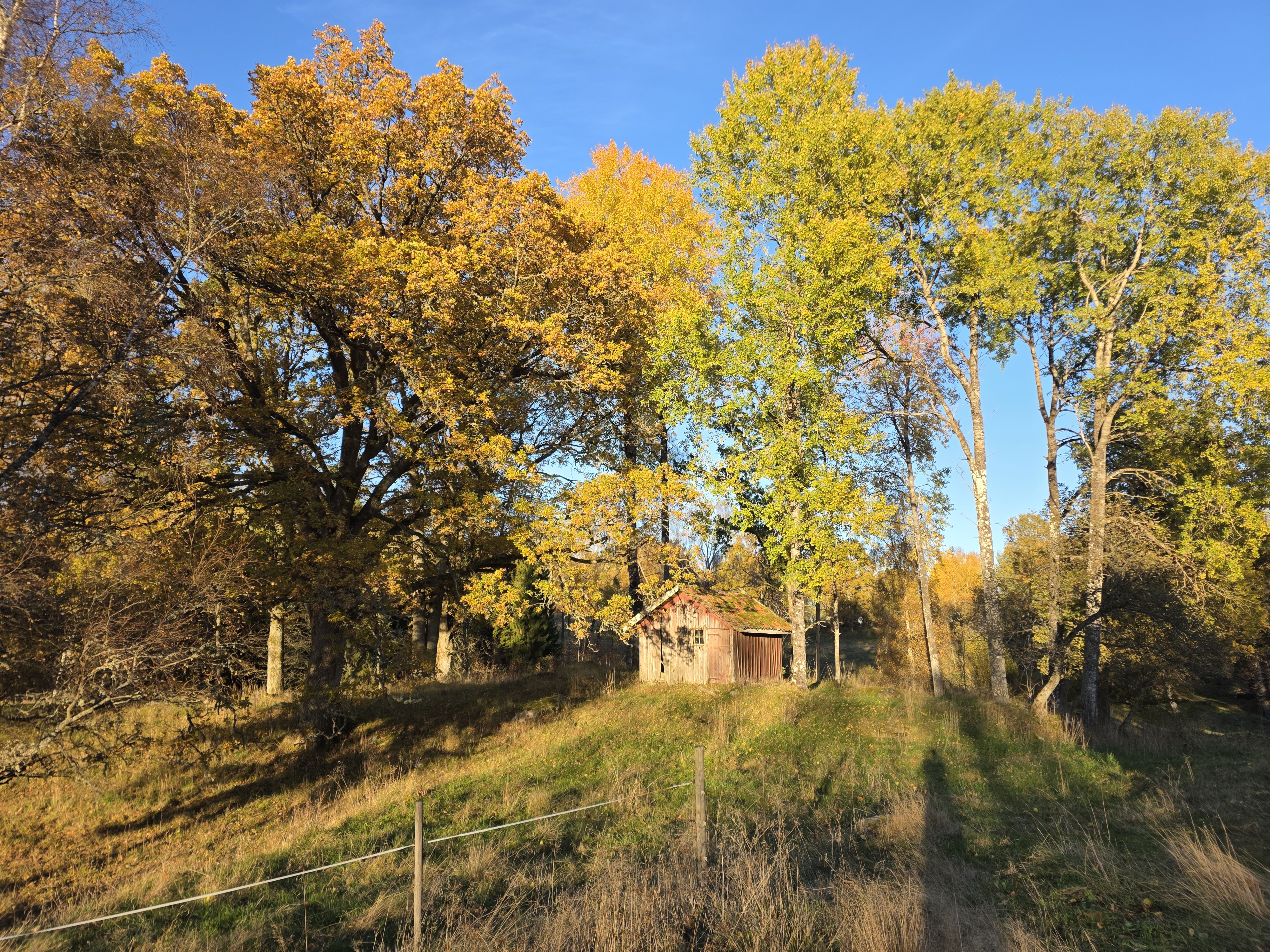
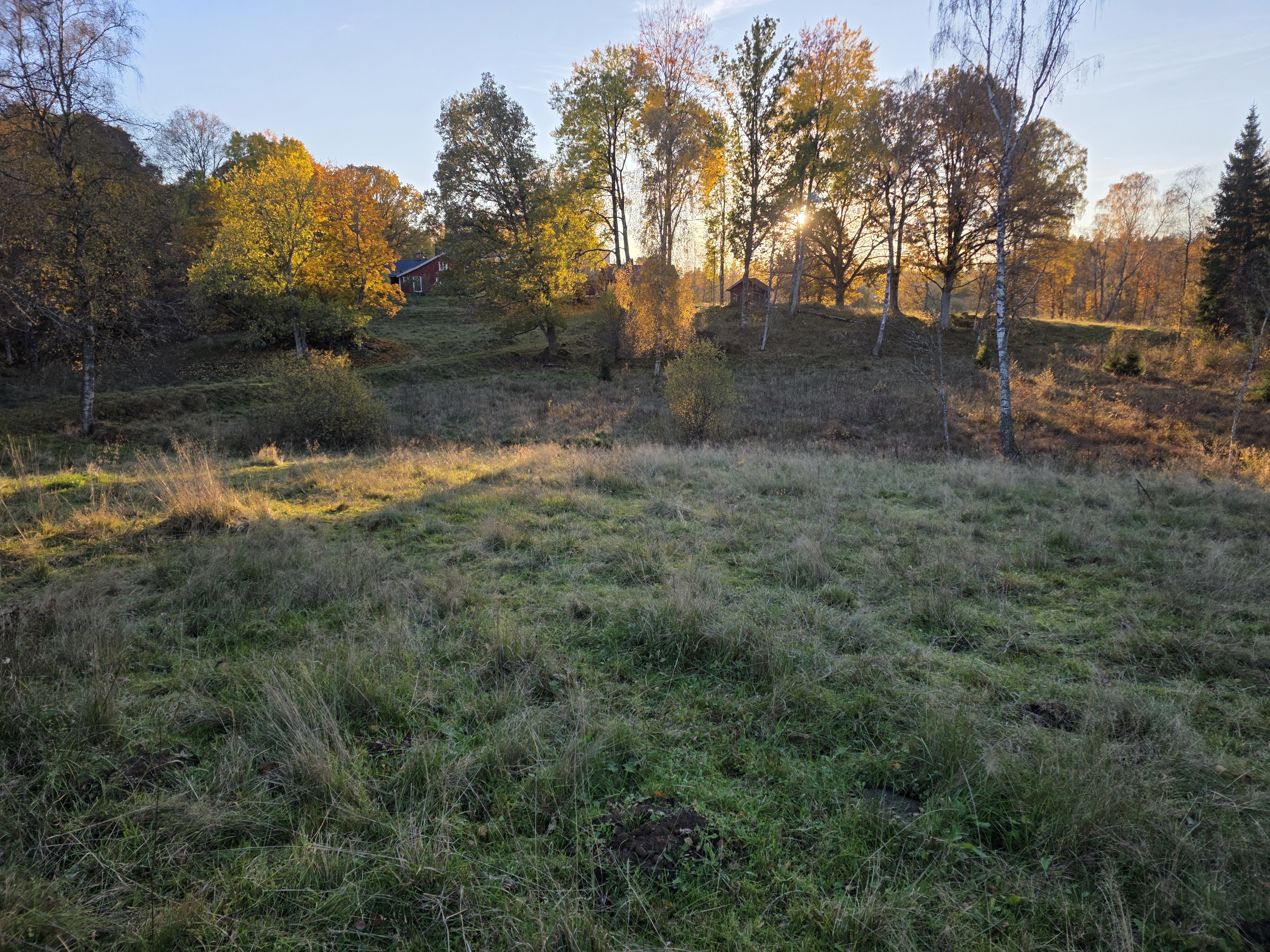
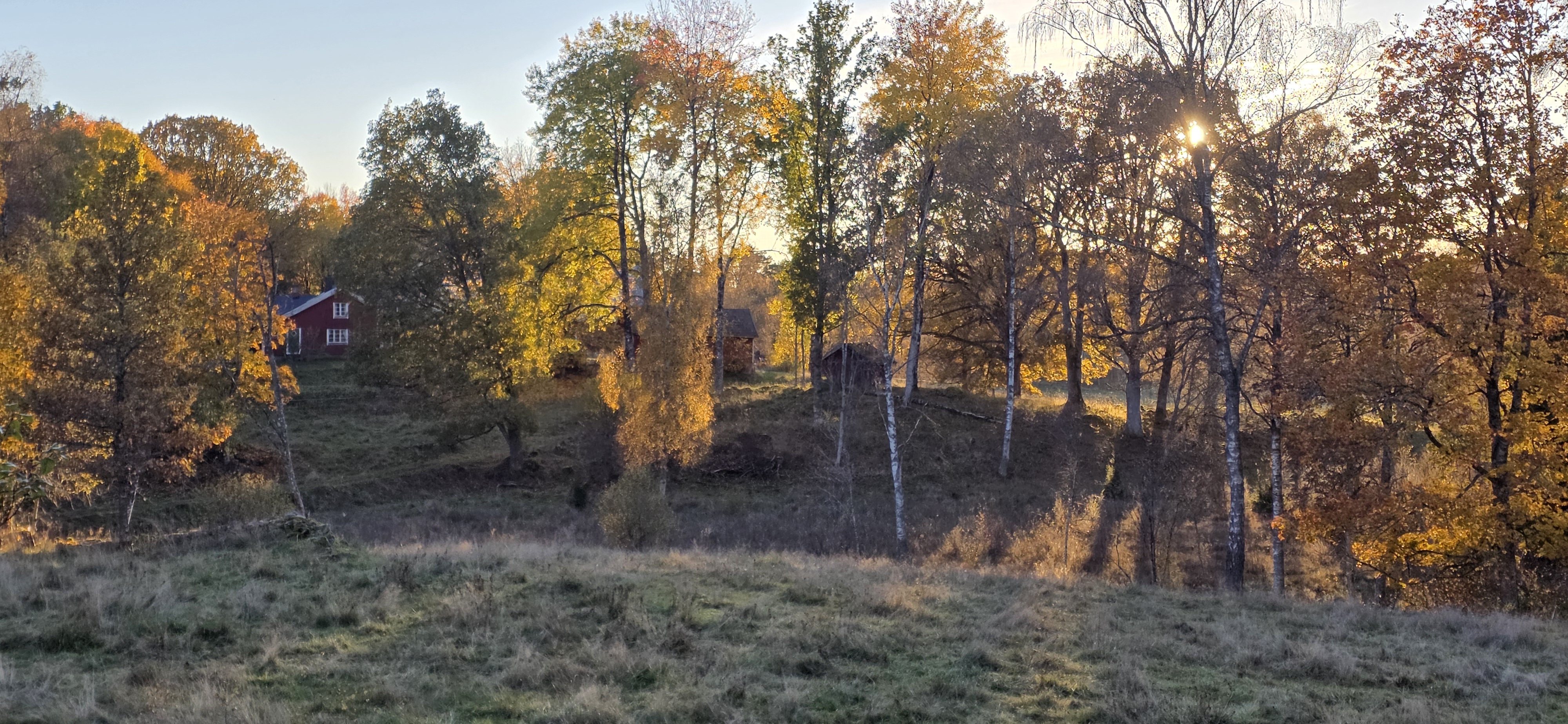
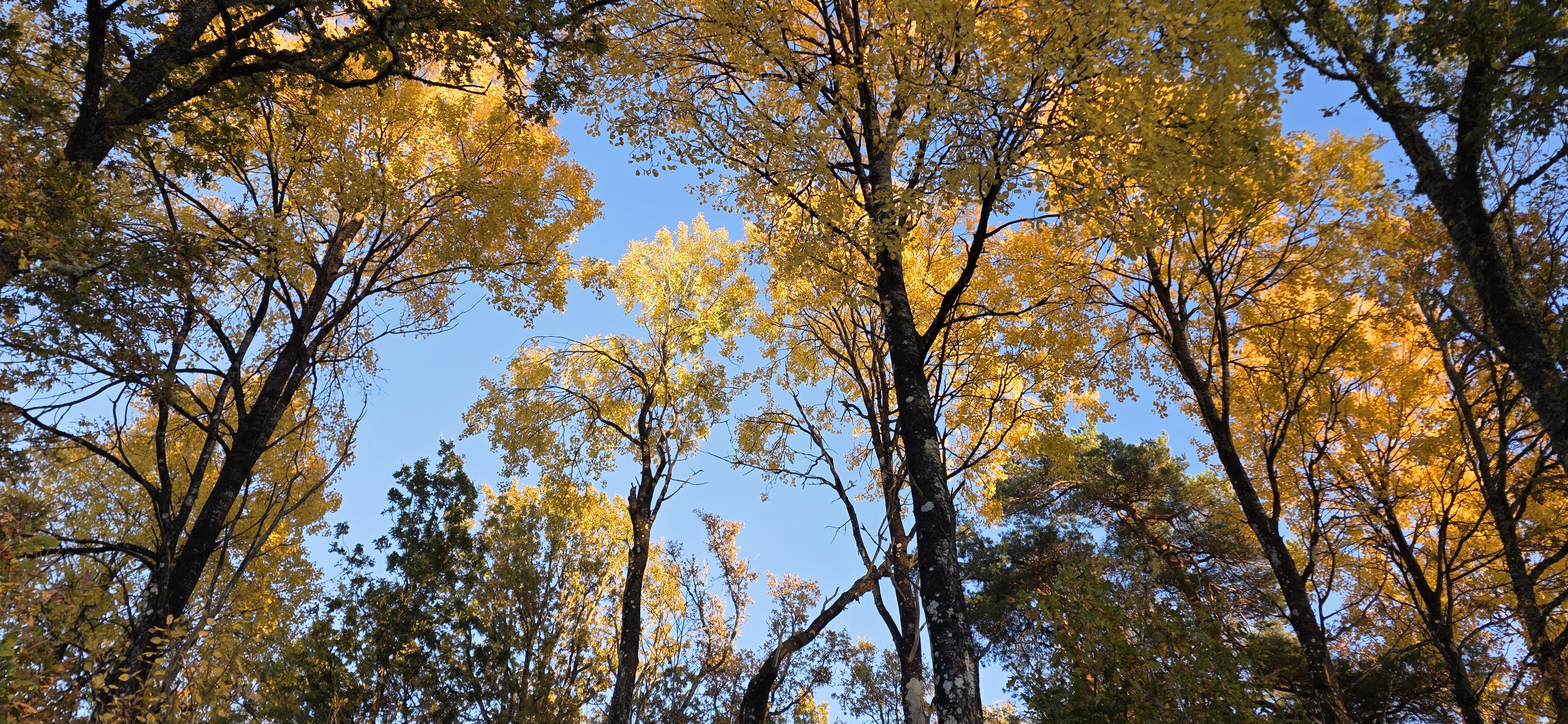
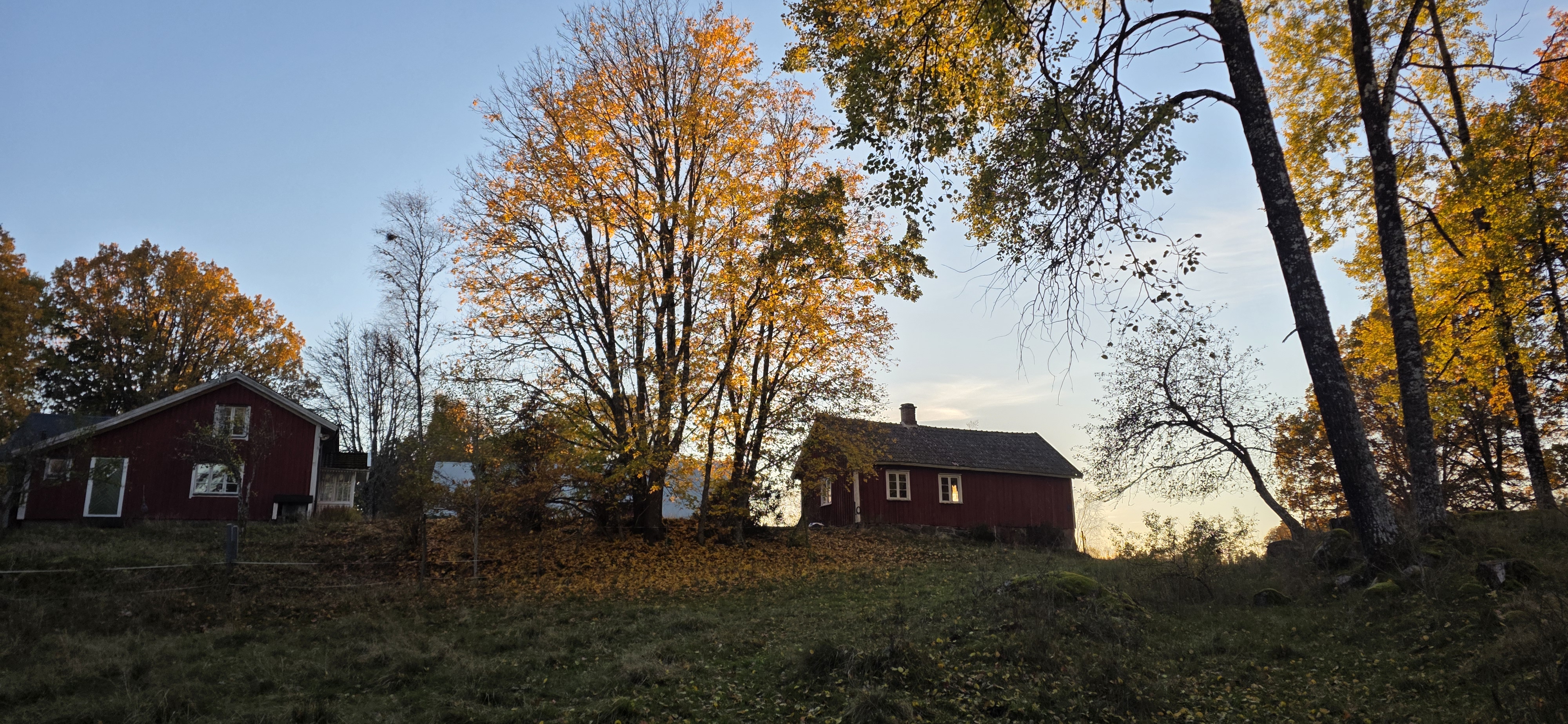
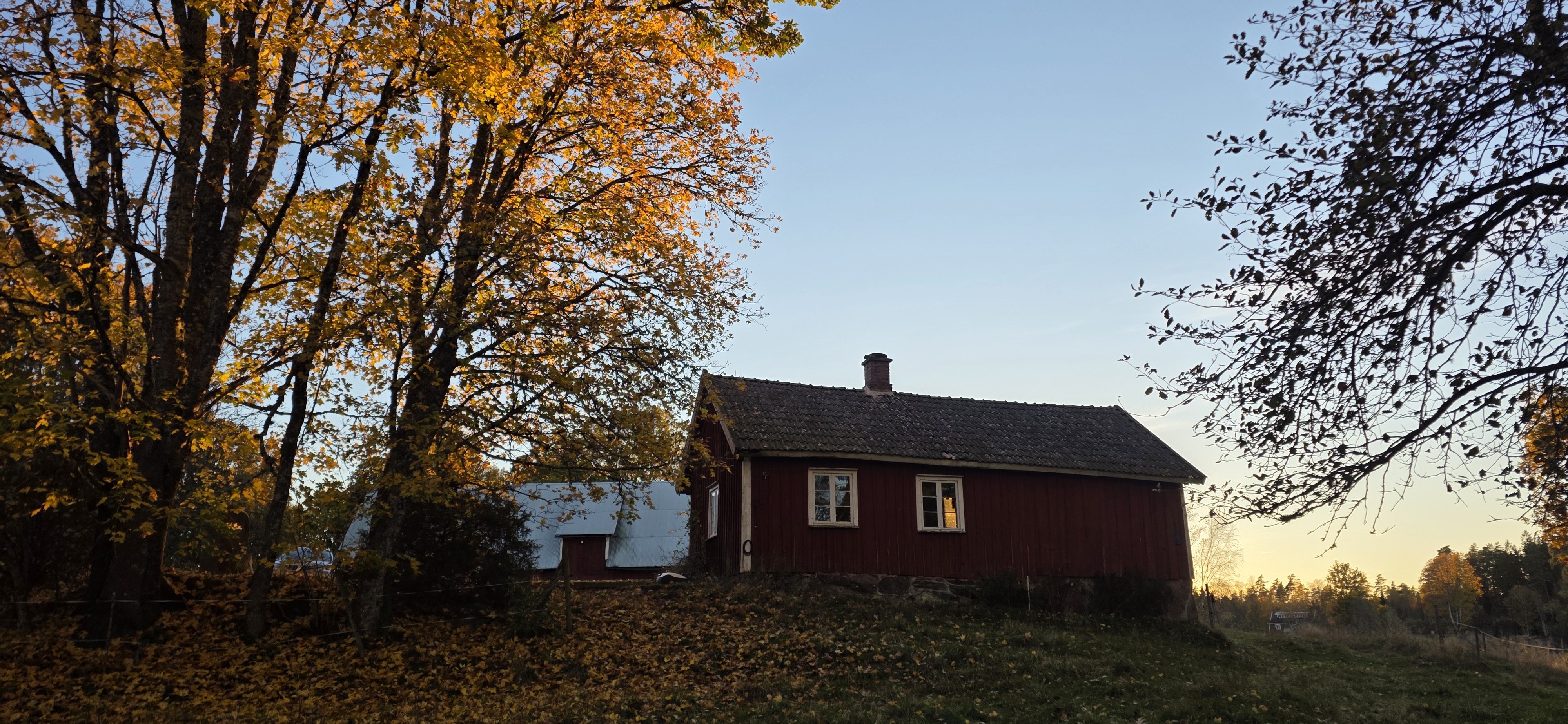
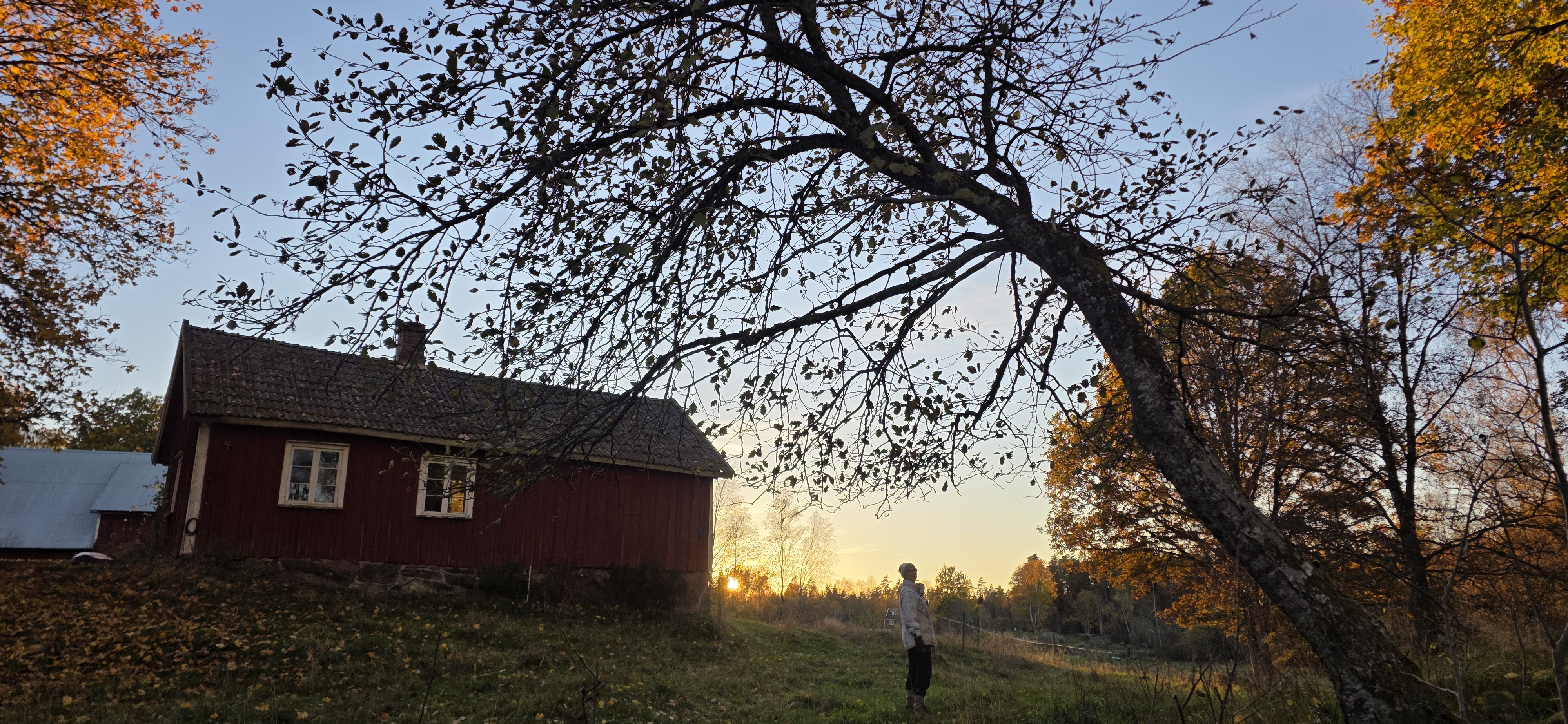
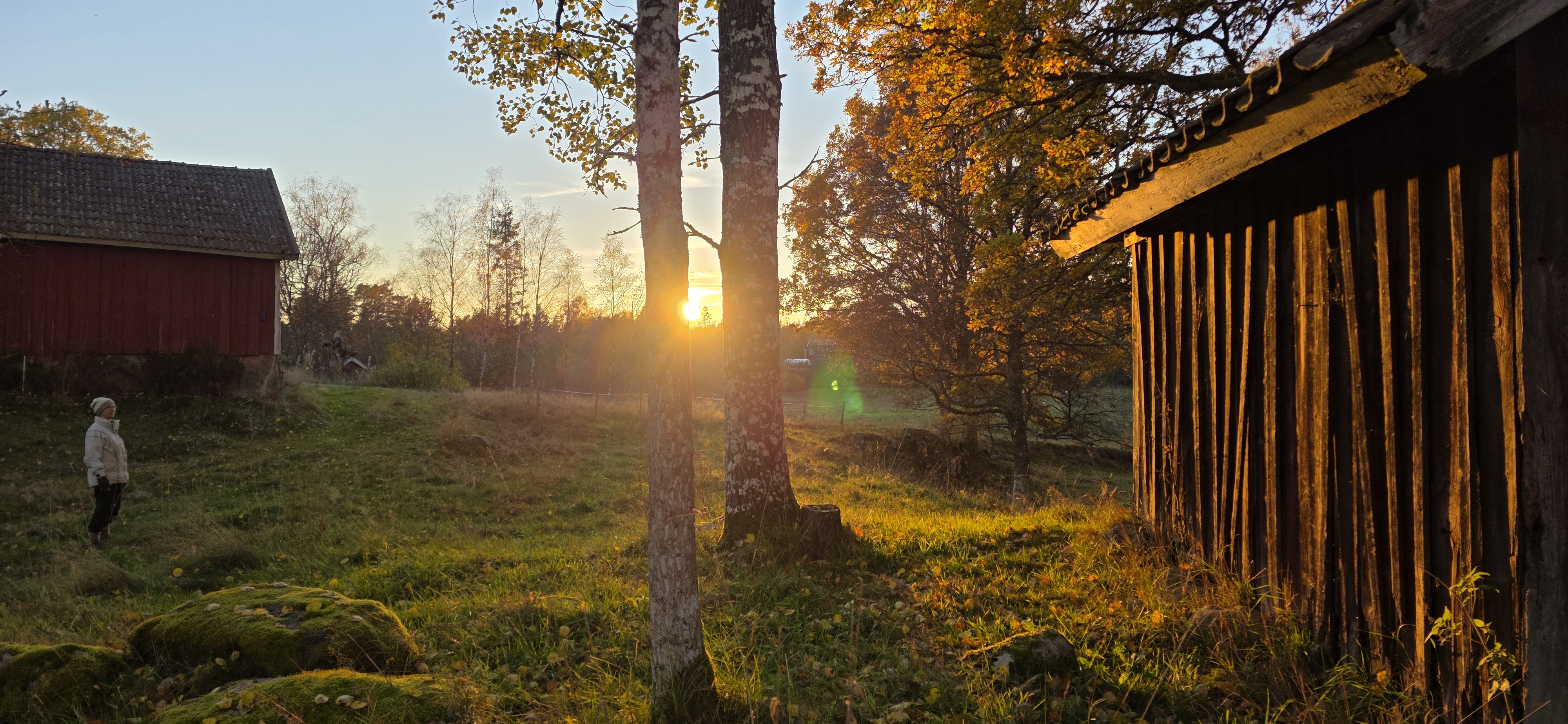
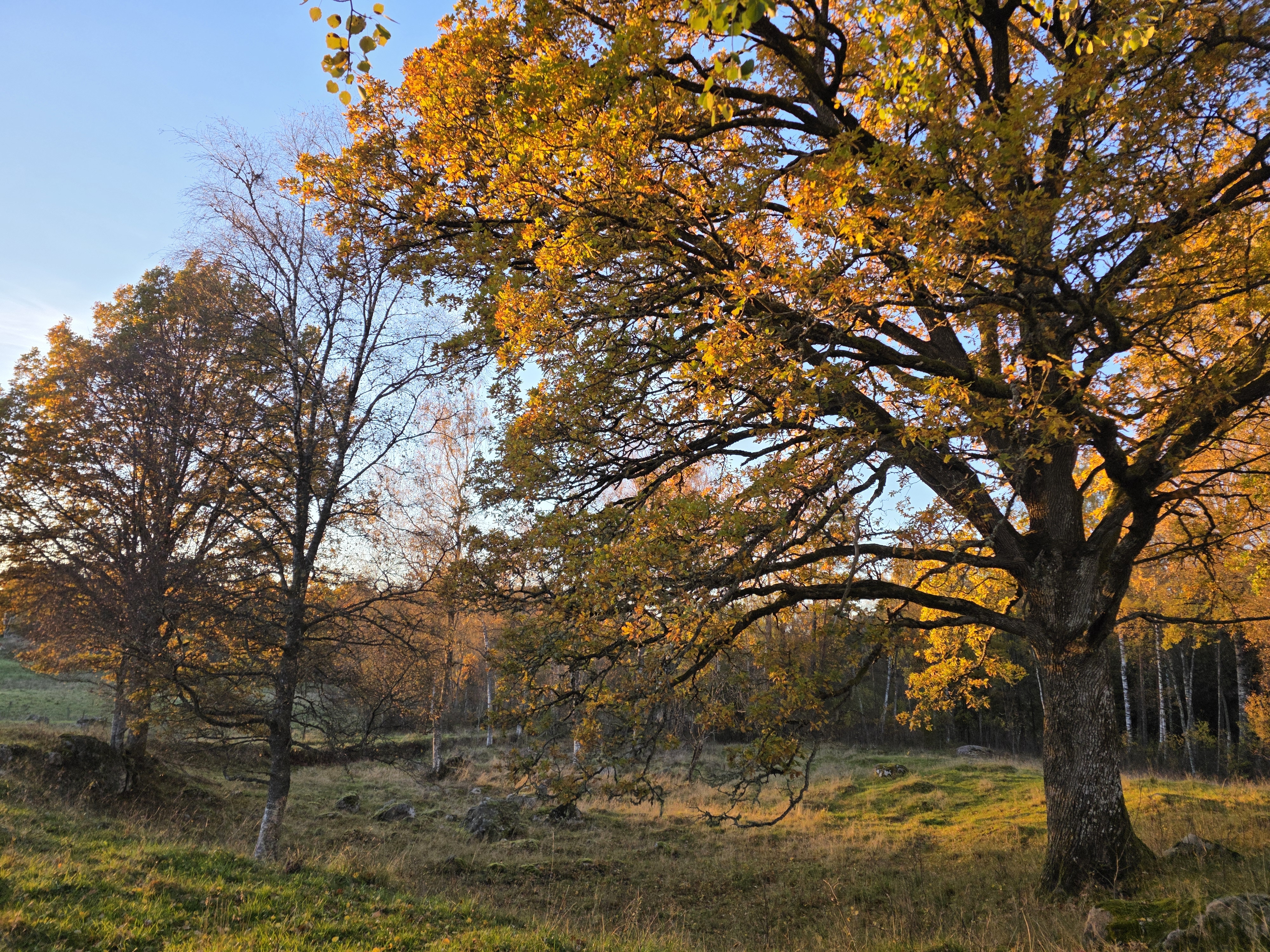
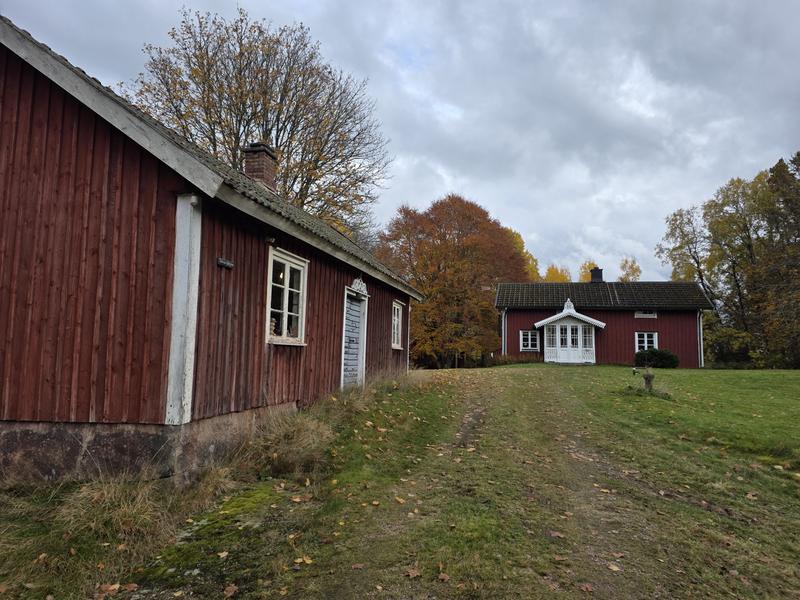
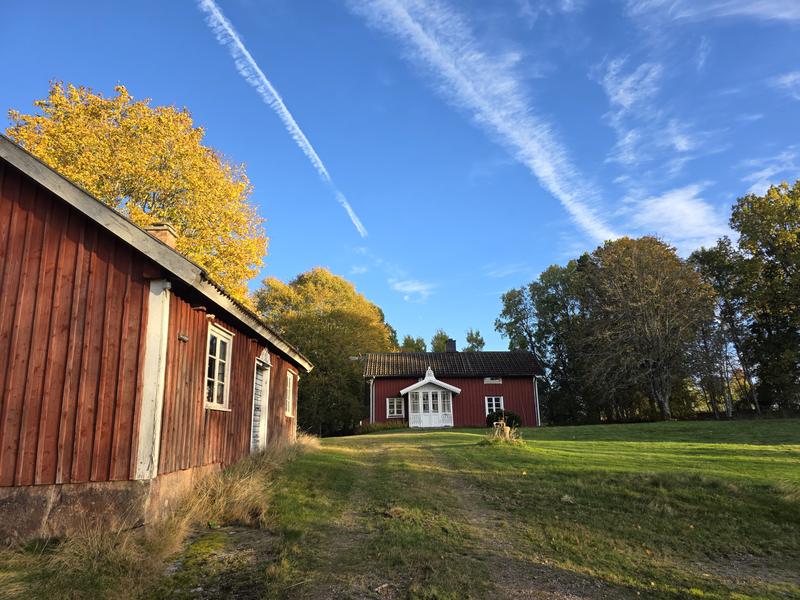
My knee wasn't so sore that we couldn't walk in the fields where the cows had been until last week. It was the golden hour, and it wasn't just golden; it was so rich in color, a feast for the eyes. I accidentally stepped in cow poop, though, and that tempered the festive feelings. You cannot see that in the photos, though.
|
|
|
|
|
|
|
|
|
|
|
|
|
|
|
|
|
|
|
|
|
|
|
|
|
|
|
We had dinner, then relaxed in the living room. DW knitted a vest named "Martall" in Swedish. The pattern is supposed to look like the bark of a Pinus sylvestris tree. I blogged. Outside the cottage, it was pitch dark. Normally, you would think that we were alone. DW turned on a lamp in the bedroom to get something for her knitting, and outside, a roe deer was startled by the sudden light. They calmed down after a while.
When we went to bed, they got upset again. I recorded their barking by holding my phone out at the front door.
You can hear the upset roe deer barking in the forest near the cottage. Pay attention to the natural, beautiful reverberation as the sound disappears into the forest. I really don't think the roe deer would attack, unlike elk. You need to be a little more cautious with elk.
Tuesday 20 October
The day started cloudy. The beautiful autumn weather peaked yesterday. No animals to be seen. DW was excited about her knitting project and a little bummed that I didn't share her excitement. I am excited about her knitting; I really am. Perhaps I was just a little too excited about a post to r/Homestead about last week's blog taking off.
Breakfast was not very efficient. It feels like it's getting harder and harder to get out in the forest every day. DW has bruises, and my right wrist is complaining a little bit. My right knee was doing better. Is it still that fun? No, not really. Now I want it all finished.
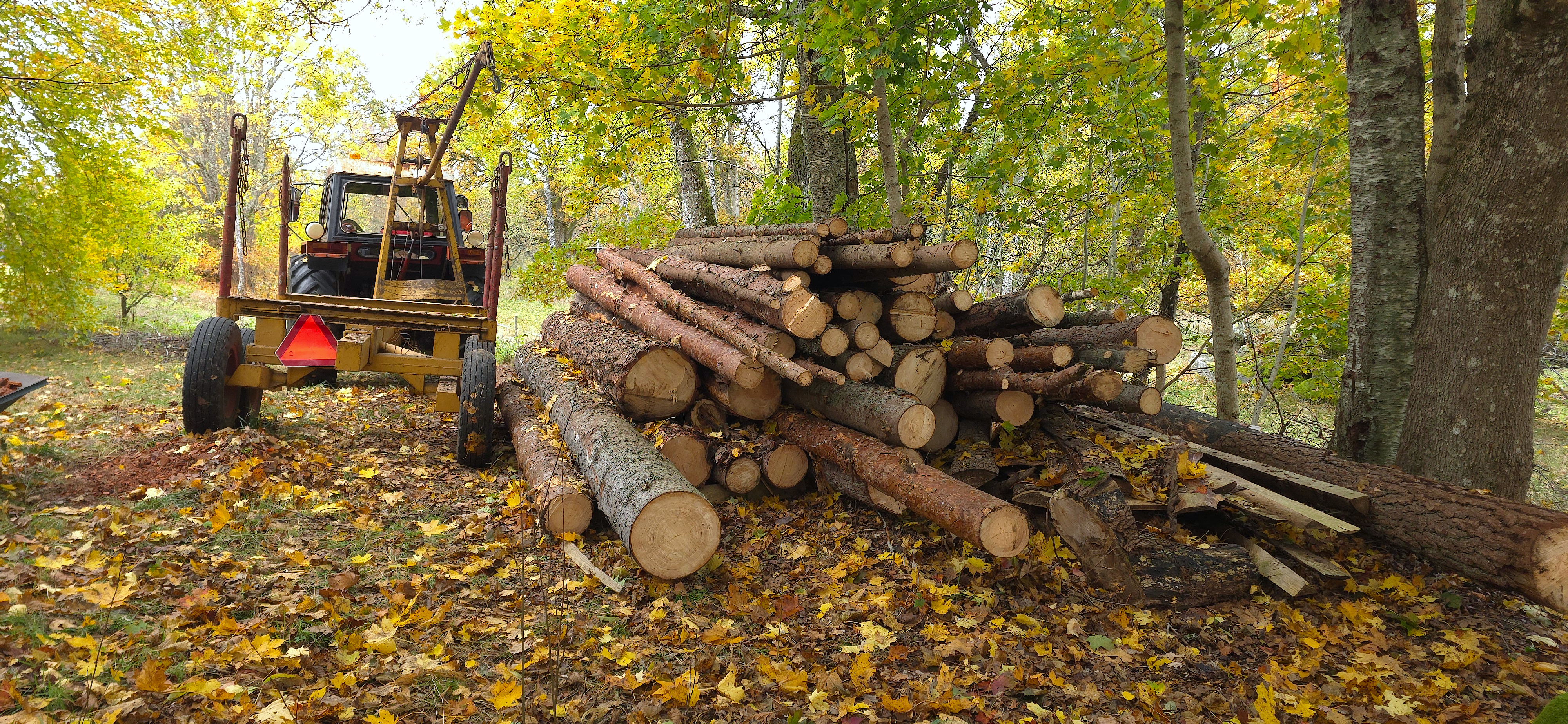 In the morning, we unloaded yesterday's carriage first. The photo is yellow because the trees around here still have yellow leaves, so the light is yellowish.
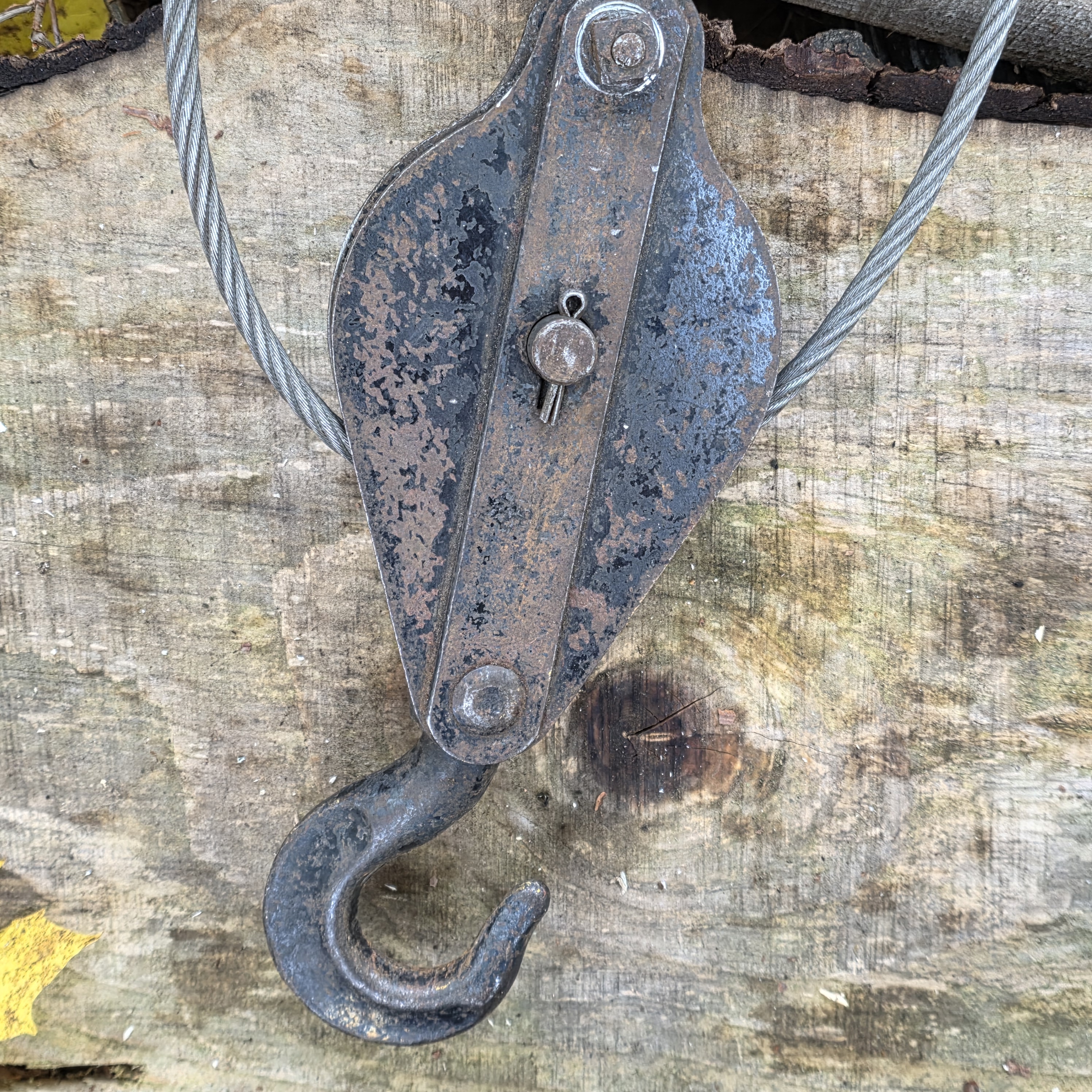 We connected the winch at the tree behind the stack via a pulley. That way, we could pull the logs onto the heap much more easily.
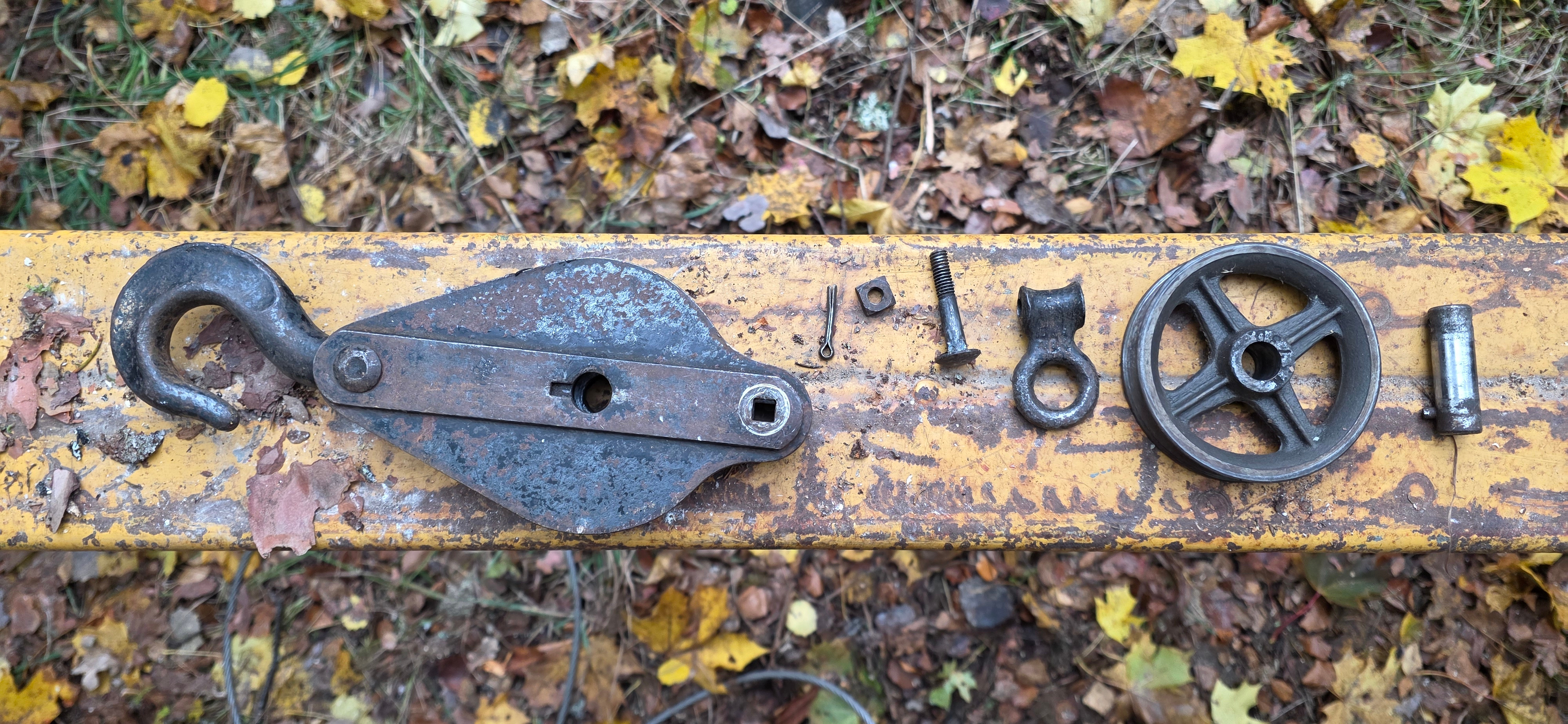 The pulley is a clever thing. It has 6 pieces. You need to take it apart completely to mount it on the winch wire. It can feel like a hassle, but the pulley gives you access to enormous amounts of power, so it's worth it.
Then it was time for lunch, and after lunch we went out again to pick more logs. This time, we took the last ones on top of the hill, then as many as we could below the road. The winch cable wasn't long enough to reach the final log, and it wasn't in good condition, so we left it.
When we came back to the cottage with our load, it started to rain lightly. We decided to leave the logs on the wagon and call it a day. If we want to use tomorrow efficiently, we can't have a slow morning; we need to unload the wagon promptly and get out to chop our picnic tree if we want to have all the trees collected during this holiday. It looks like we can get a rain-free window between 10 AM and 5 PM tomorrow.
Wednesday 21 October
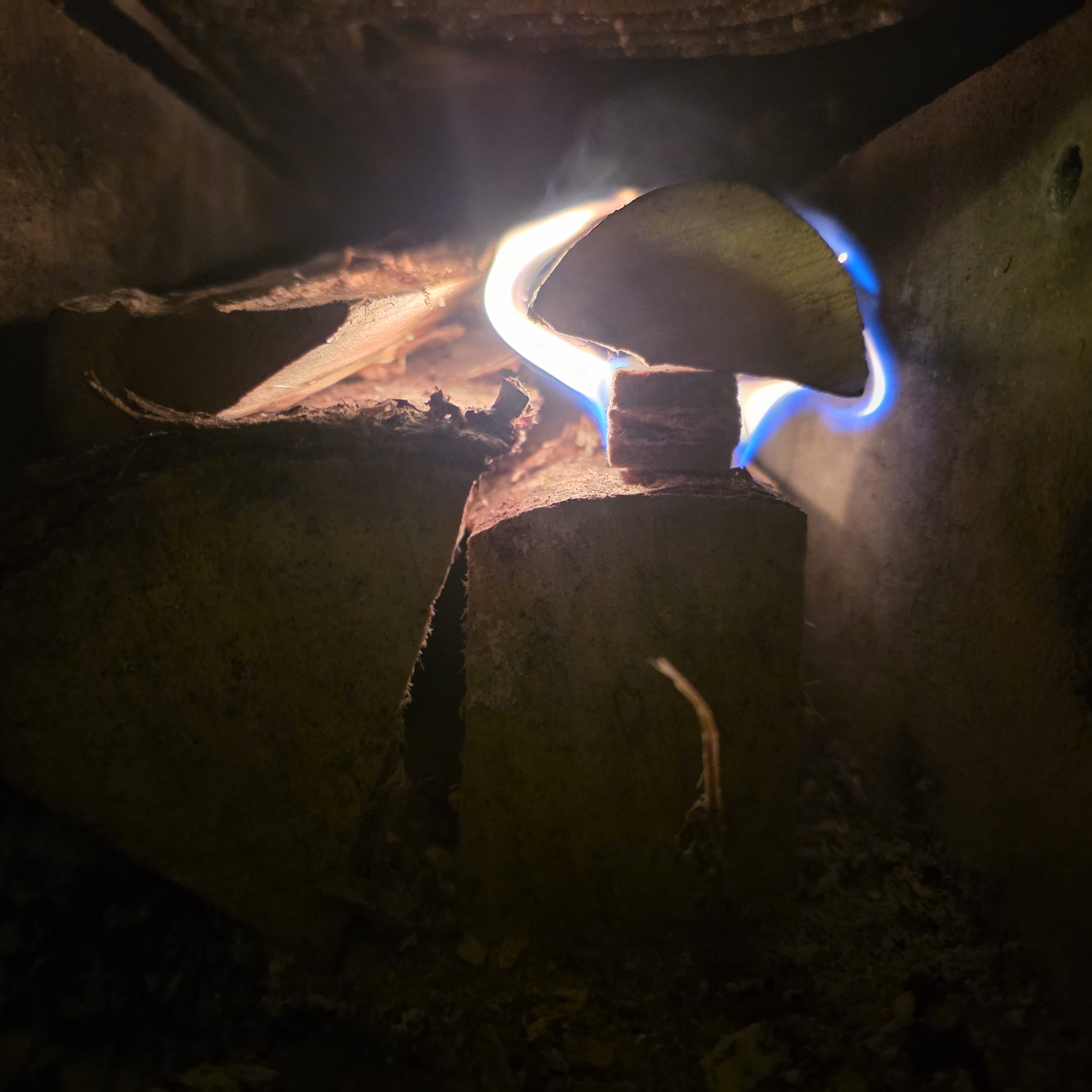 This morning, we even set the alarm to wake up on time! We couldn't have tea-in-bed blogging if we wanted to reach today's goals. It sounded energetic, as if we had complete control over our motivation, but it didn't feel that way. I got up and made a fire in the kitchen stove.
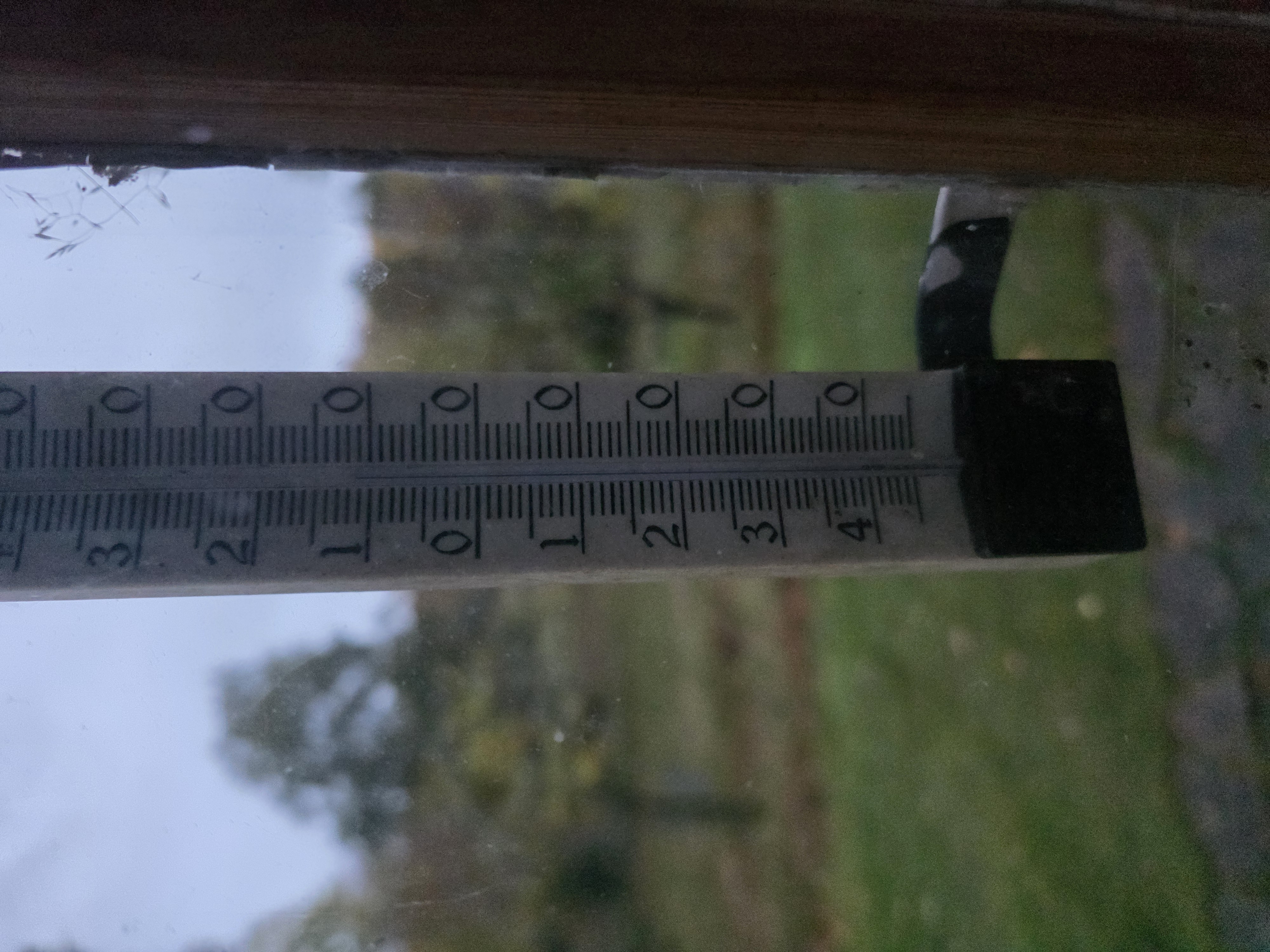 Today's temperature was 11°C, about 52°F. That is good because it means the tractor needs no motor heating.
That was all fine. I was still yawning and found this tree-hauling project a little tiring after all. It does not help that we are not getting any sun today. It was going to be drizzly weather all day, with real rain at some point in the afternoon.
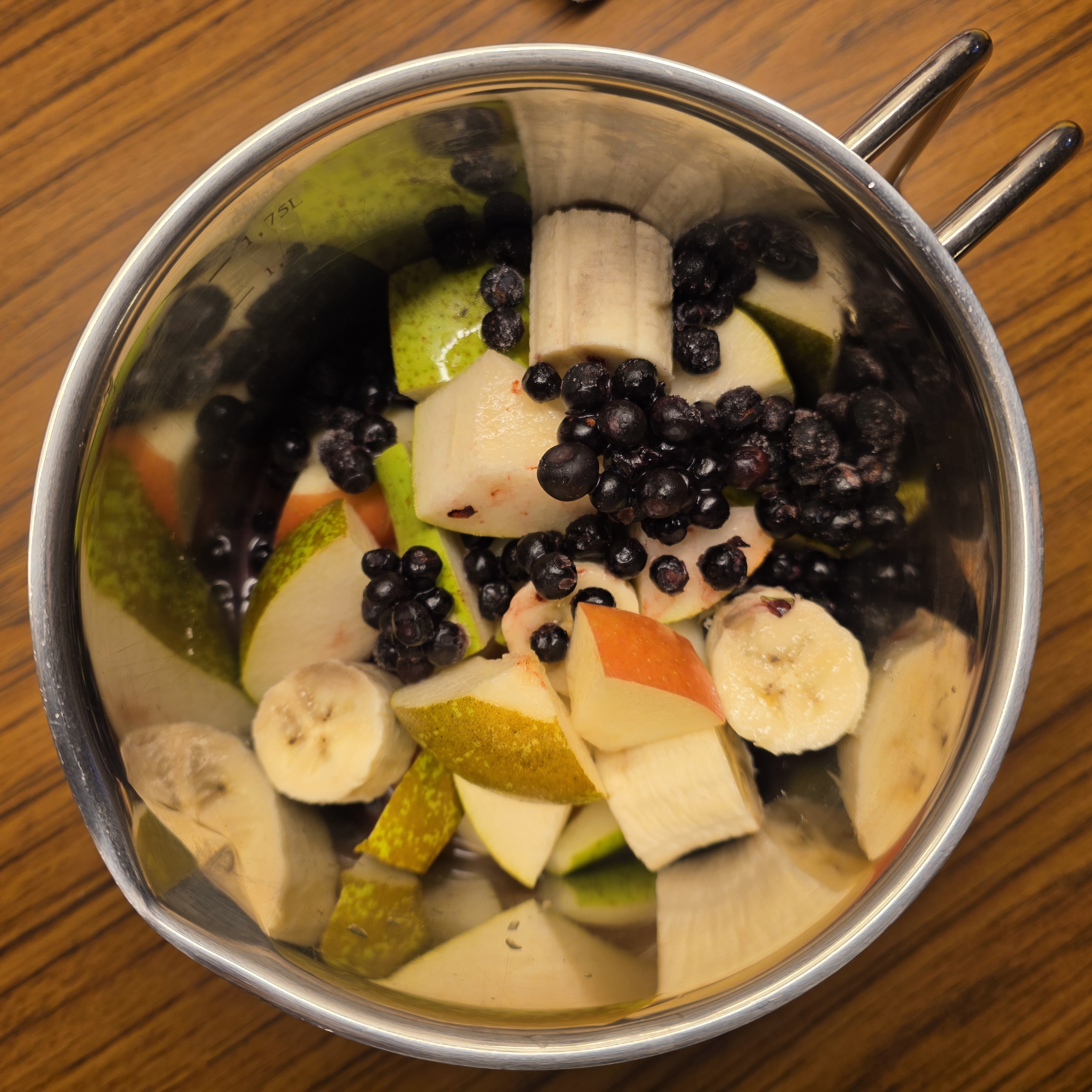 I made a smoothie with frozen grocery-store bilberries again. I added a conference pear, organic Gala apples, an organic banana, and organic orange juice from concentrate.
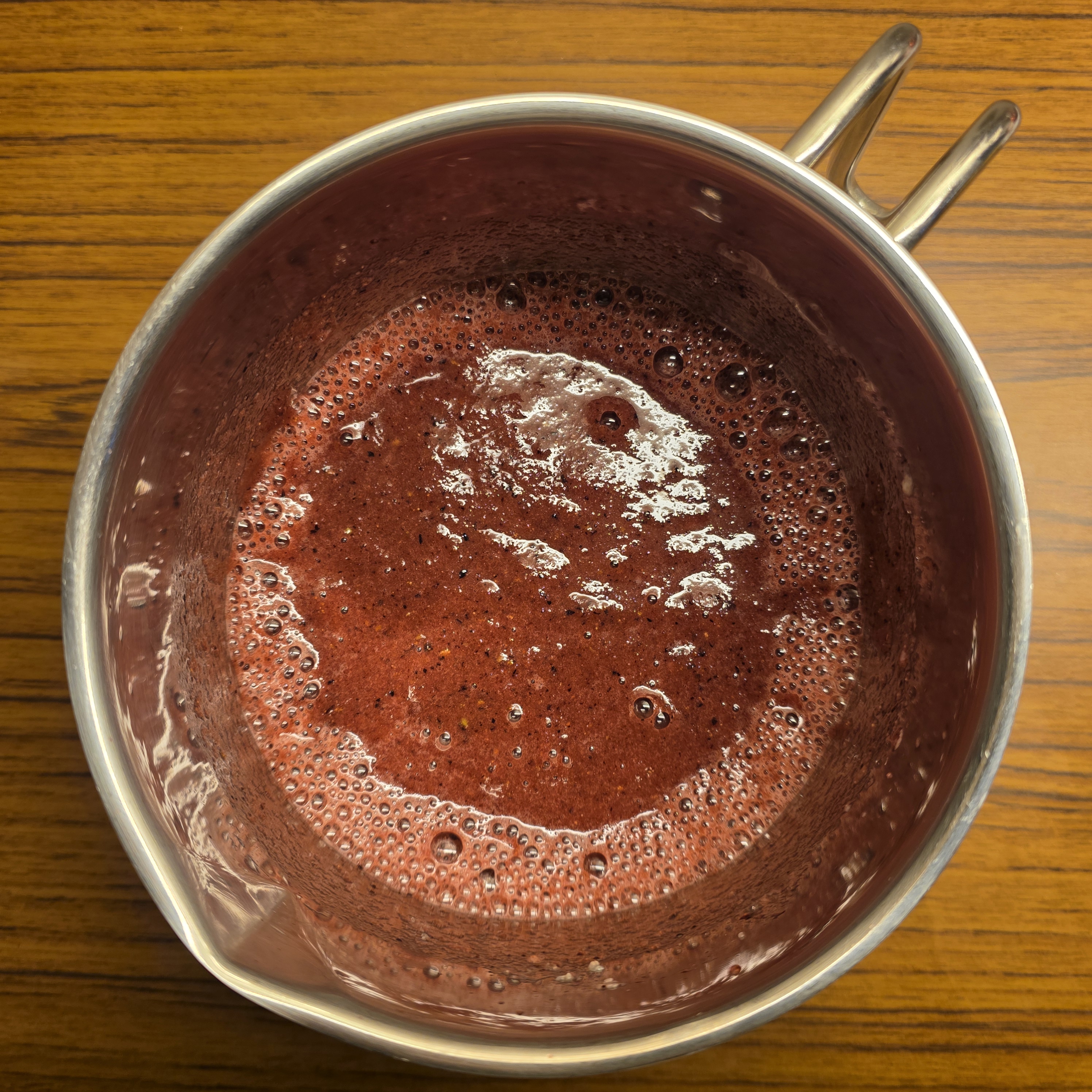 Then the fruit mix is blended. That is it; that is the whole idea of the smoothie. The smoothie has no other additives. We keep it simple.
All smoothie ingredients are regular, but I must say a couple of words about the orange juice because I find it so special.
The orange juice is made from concentrate. That is so clever. It comes in a tiny little package, and you add 4 packages of water; you can use tap water. The waste is just a little paper package. We do not have this in the Netherlands. It is a Swedish thing. In the Netherlands, you have to buy the orange juice mixed with water.
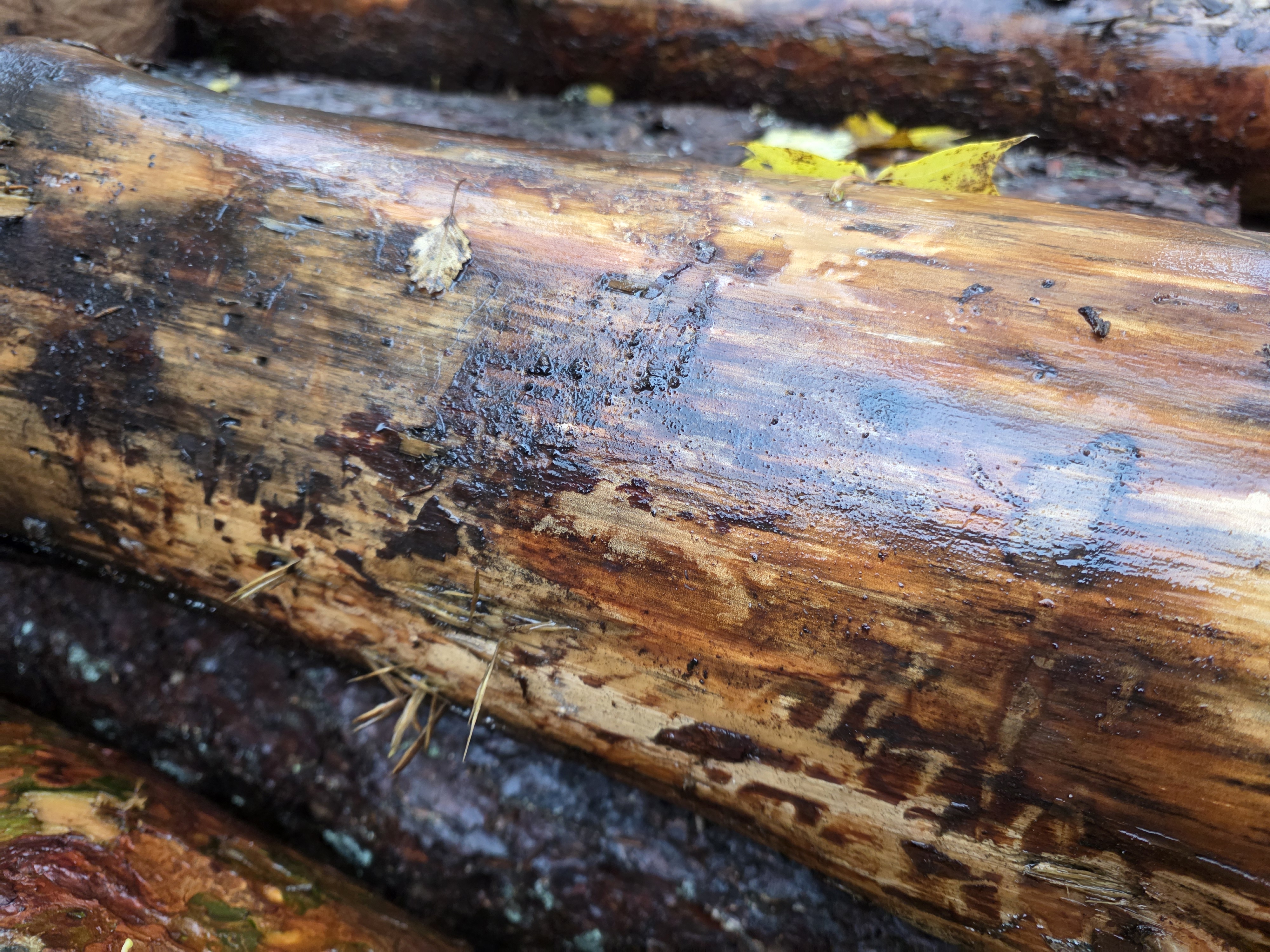 After a while, we finished our smoothie and went outside to haul logs from the forest. Today, every surface was a little moist. Conditions had changed. Vigorous walking on the logs was not a good idea; they had become slippery. Especially the logs of lower quality. They often lost their bark, and what was left was a soapy surface in drizzly weather.
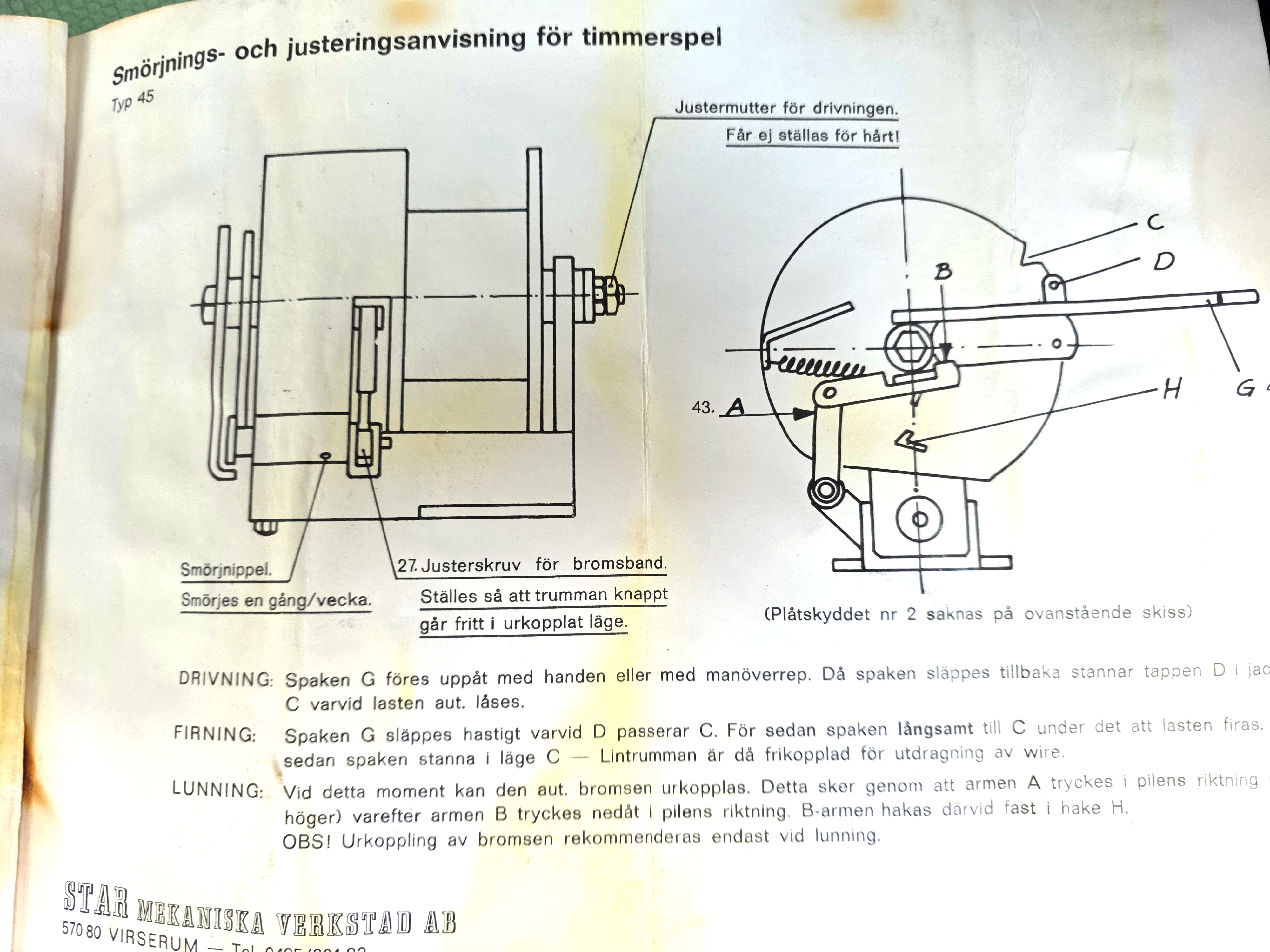 But first we had to empty the wagon. For that, we used the winch crane, and it was tired of hauling logs, too. It was as if the winch wire wouldn't lock when it was supposed to. In that sense, it had become a useless crane. I even opened the manual and started reading about adjusting the brake mechanism. I tried it, but it didn't work. I lubricated it; honestly, it hasn't been lubricated that often. I thought the brake had gotten stuck in the damp weather. After a while, it simply started working again, which was good enough for me. With the wagon unloaded, we headed into the forest.
We went to the forest without the tractor because we needed to prepare first.
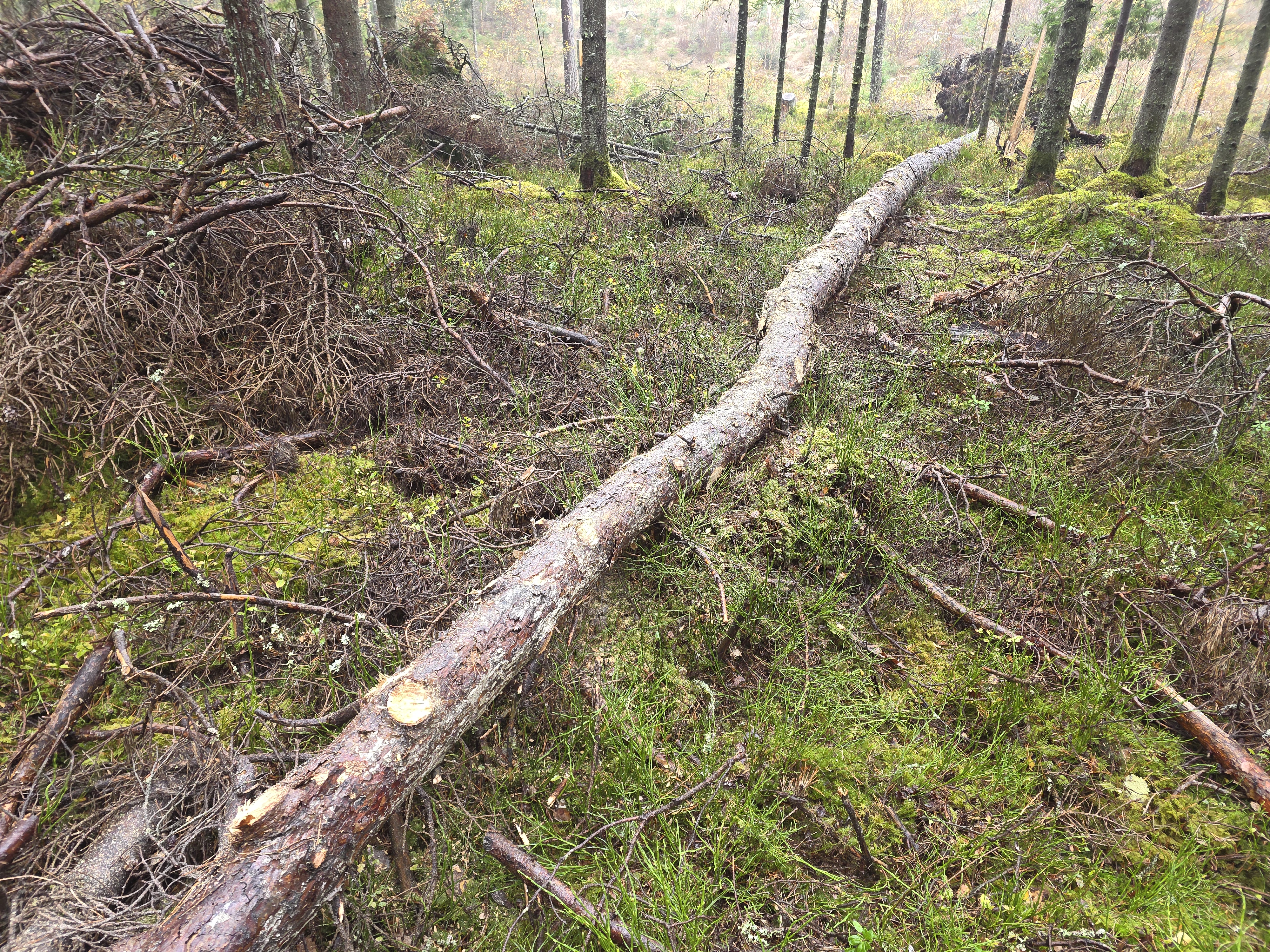 This was the tree we had decided to harvest today. After a close inspection, it wasn't in excellent condition. It had been lying here for a while. We hoped we could still get some heating value out of it, so we didn't push it aside; instead, we chopped it into pieces.
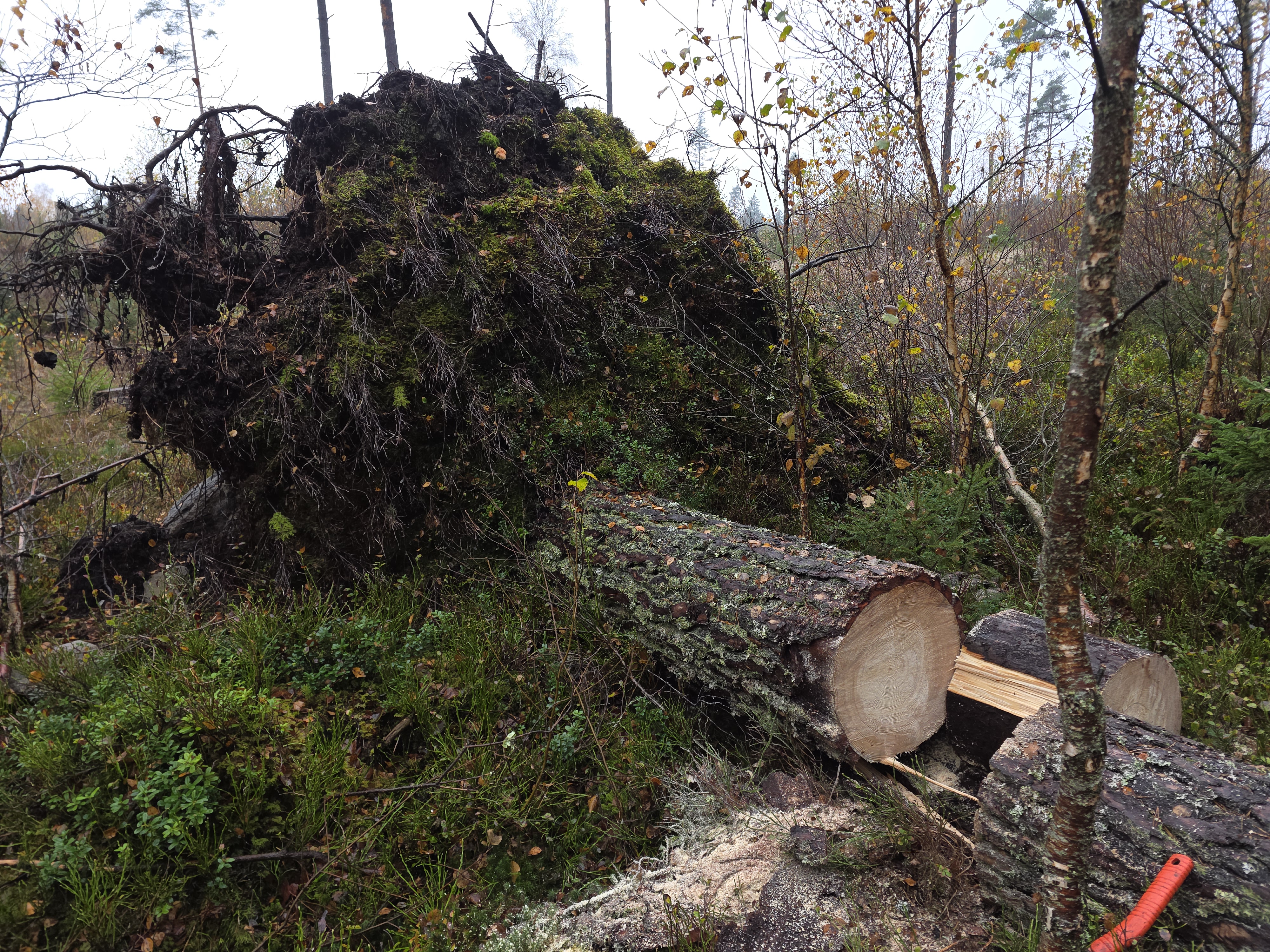 When I got to the rootball, the ball refused to fall back into its hole. It was a mystery. I even cut out an extra piece of the log, but that didn't help either. Now, if you look closely at the photo, you might notice a small piece of wood between the log and the stump. I did not see that. Instead, we went home to have lunch.
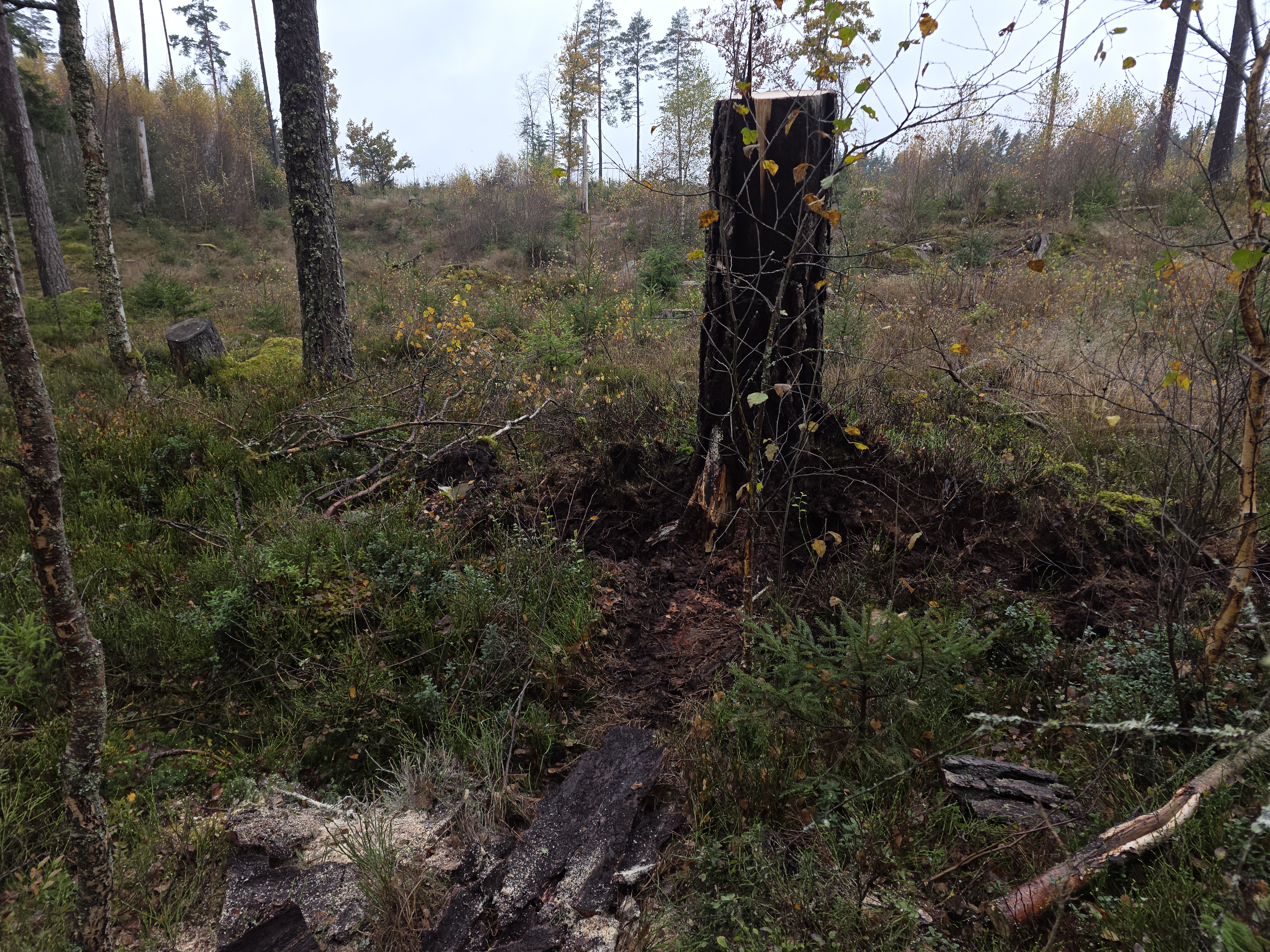 After lunch, we came back with the tractor. The first log I hauled was the one nearest to the rootball. Something cracked, and the rootball decided to go back into its hole. Beautiful! It was unexpected, but so logical: a thin stroke of wood held the rootball in place. That is the thing with handling logs: beforehand, you are clueless. After the chain gets pinched, or in this case, when the rootball falls back, it makes sense.
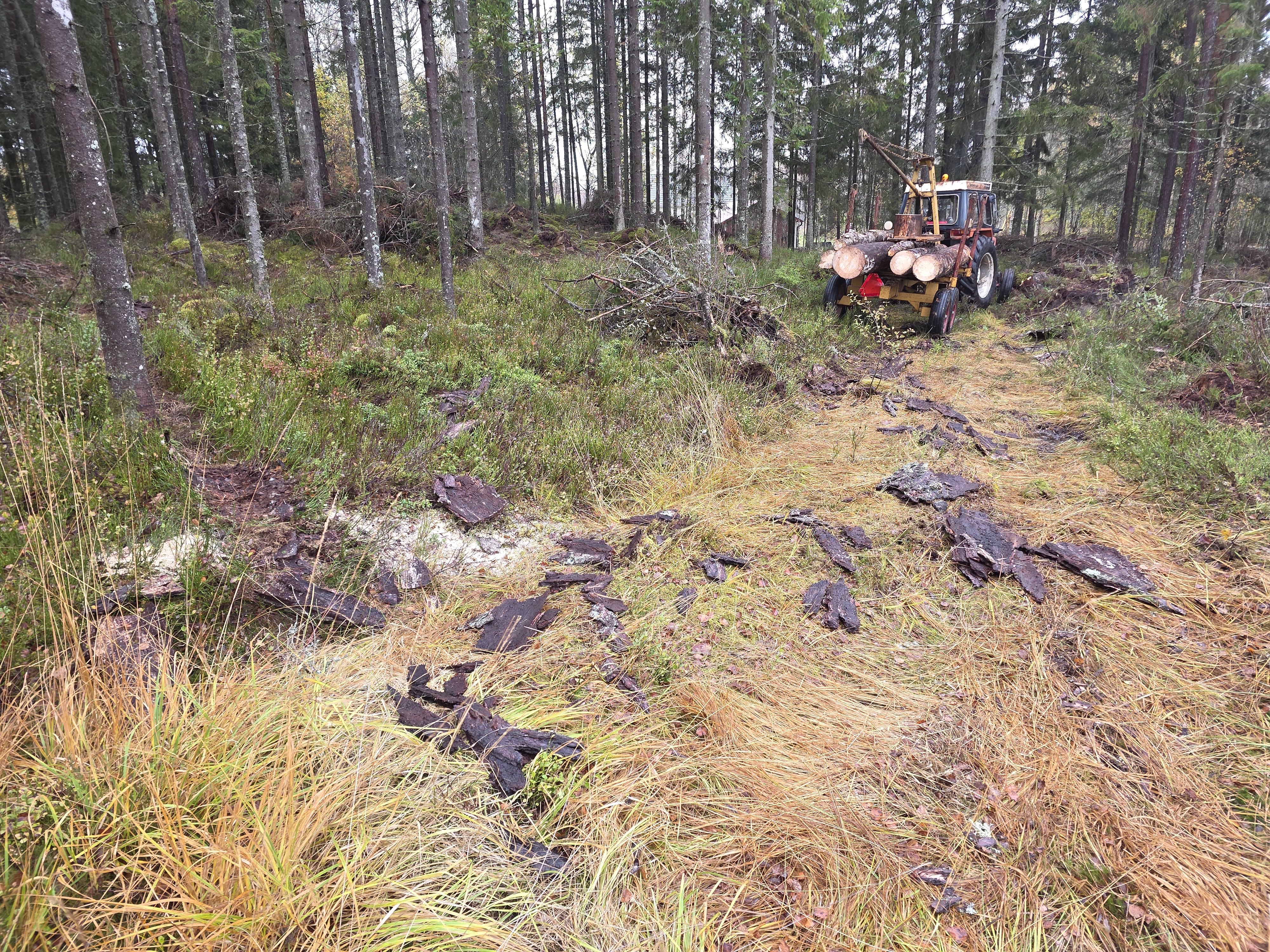 We loaded all the log pieces onto the wagon. It wasn't a good-quality log, but it was so long and in the way of other future activities that we wanted it removed anyway. The bark fell off in large chunks when we dragged the logs onto the wagon. Below the bark was a thin, mushy, slippery layer. That mushy substance covered my gloves, pants, and coat. I think I even had it in my face. DW was not delighted to get a kiss from me.
It felt great to finish this part of the project. Some stubs are left, but they are good for birds that want to build holes in them. We had one hour before the drizzle turned into steady rain, so we drove to the cottage and unloaded the slippery logs. You would think a slippery log would be easier to stack, but it was difficult. We left the largest log in front of the heap. Even if it is a little bad on the surface, we can probably get it to warm us on a cold winter day.
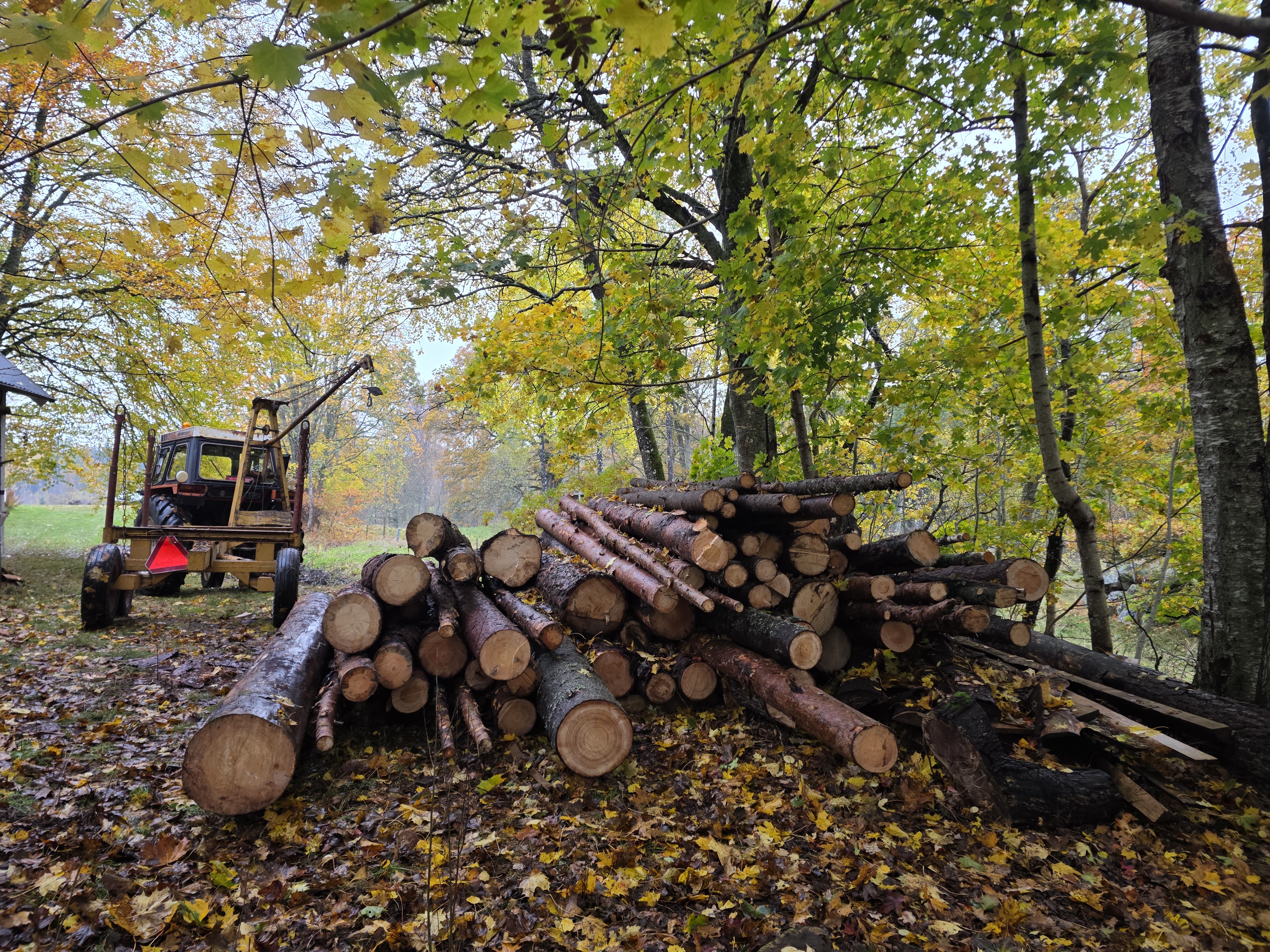 It is an impressive heap of logs. I counted about 75 pieces. It could be more or less, but on average. DW figured out that we cut an average of 4 pieces from each trunk. That means that about 18 or 19 trees had fallen over. I do hope the rest of the trees at this location can withstand a couple of storms. We have enough logs now for our personal use. We aim to use only storm-fallen trees for heating at the cottage. I think we can keep it like that for a while.
When we were finished, it started raining, and I took a nap. A well-deserved nap. After a day of solving practical issues in the forest, I woke up to a message that I needed to update my web server because of a PHP bug. So I did. It was also a good time to harden my server. I really wouldn't want my site hacked. That is one reason I don't use WordPress and loads of third-party libraries. My site is simple; I built it from scratch. I have seen hackers try to break into my site as if it were WordPress, but it isn't. So keeping it simple makes it more secure.
The same simple idea also applies to hauling trees. Last week I wrote about what it would be like if we weren't hauling tree logs with a simple winch crane but with a hydraulic grip arm. It would be nice to replace the winch crane and keep the rest, but that doesn't seem possible. I would need an all-terrain vehicle with a special wagon and a hydraulic crane on that wagon. It would be an immense investment. Not only that, but it would also attract thieves. Our current setup is that the entire cottage is full of old, unattractive things. Simple, but they work. The place slowly turns into a museum.
Thursday 22 October
It rained. DW knitted, and I blogged. The tractor waited in front of the barn door where we keep the wagon.
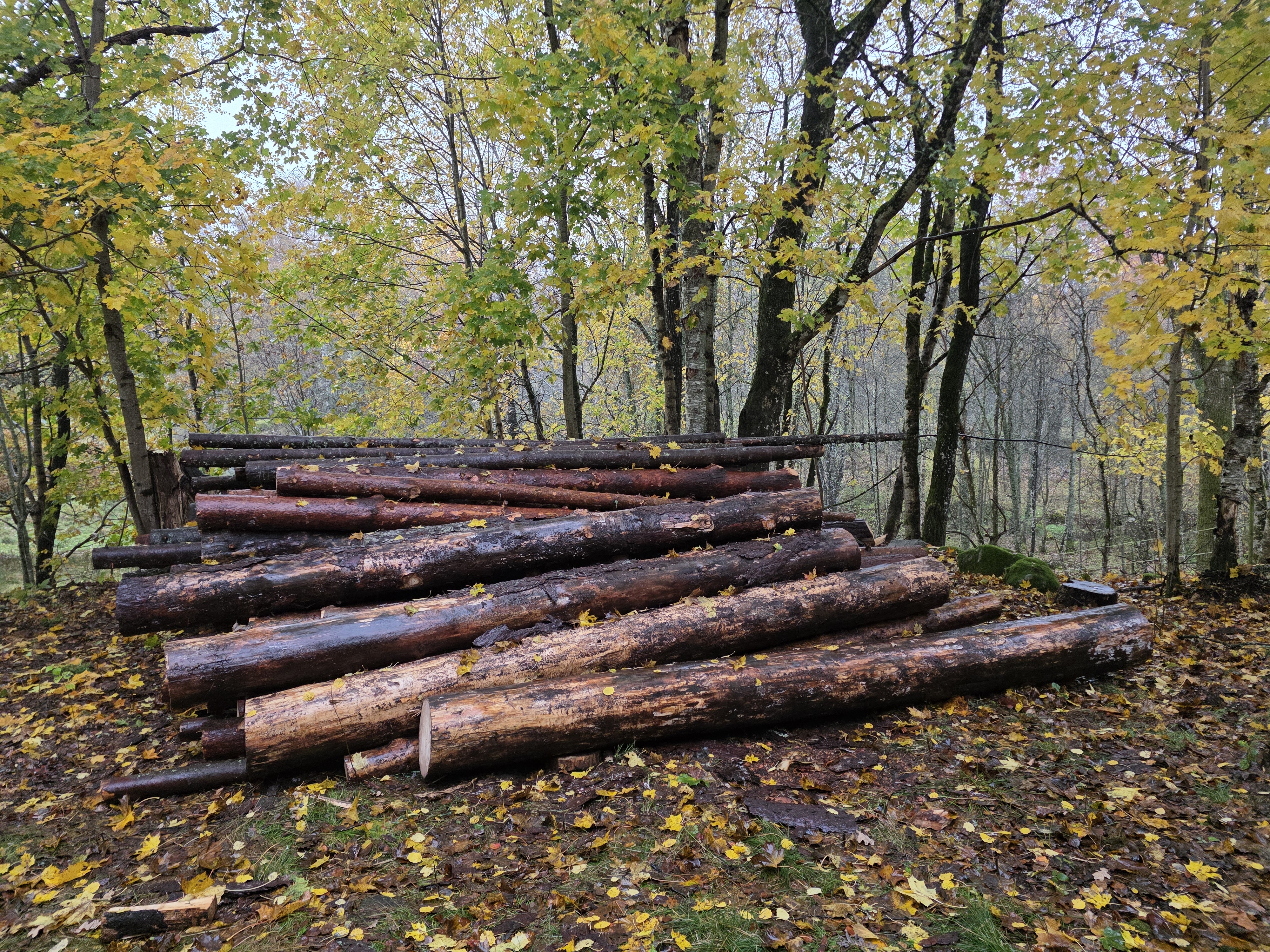 I went to the wood house to fetch more chunks of wood for the kitchen stove. When I stood there in the doorway, looking out over the result of our hauling effort, I thought that this was one of the many ways resilience looks. We need to come here, chop logs into pieces, and cleave them. It is a process over several years.
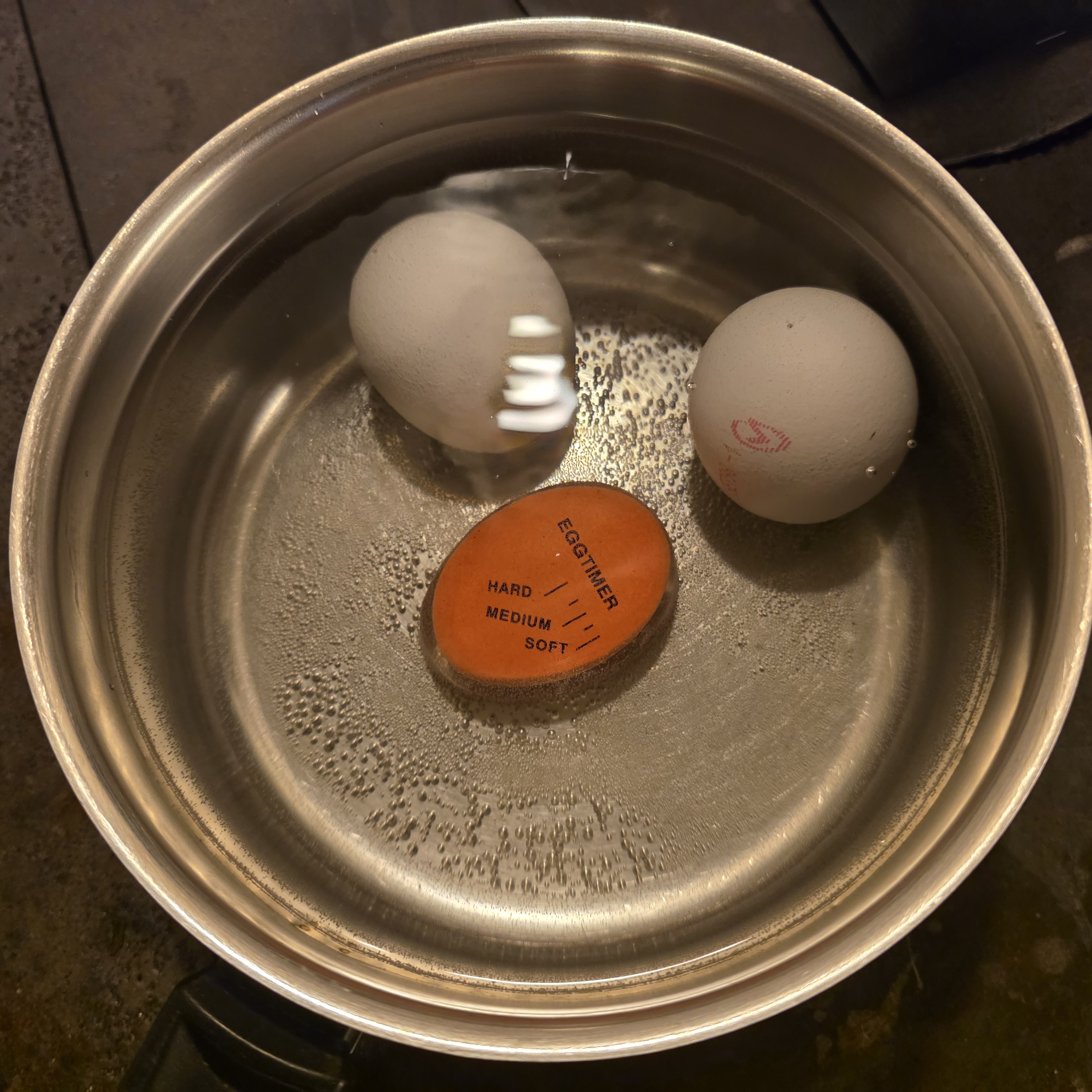 Today I decided to boil two eggs for breakfast on the woodstove. At home, we got an electric stove; boiling an egg is simple, but how do you boil a perfect egg on a woodstove with uneven heat? We got a little transparent egg timer that you put in the water together with the eggs. It starts bright orange.
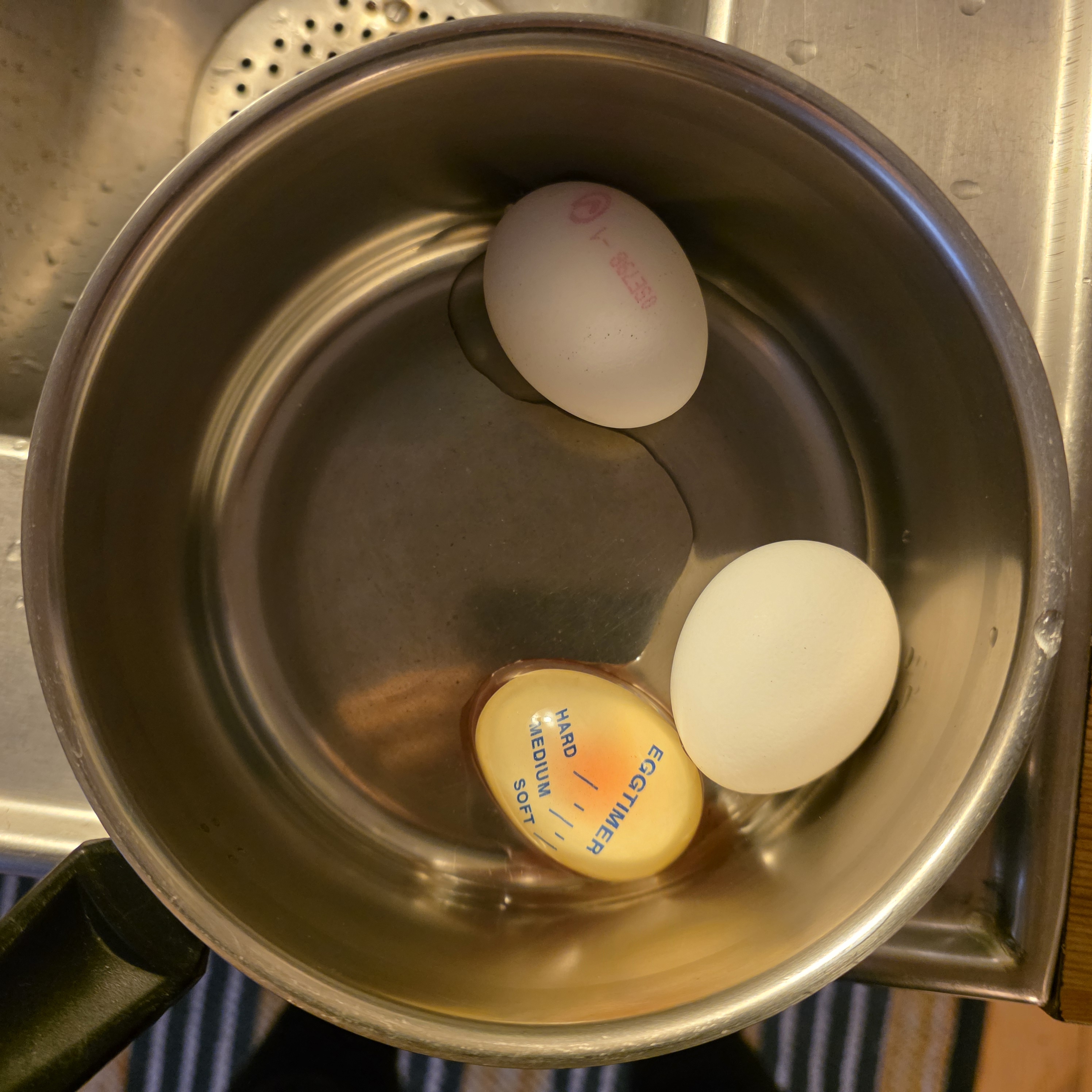 When the egg timer turns almost yellow, take the pan off the fire.
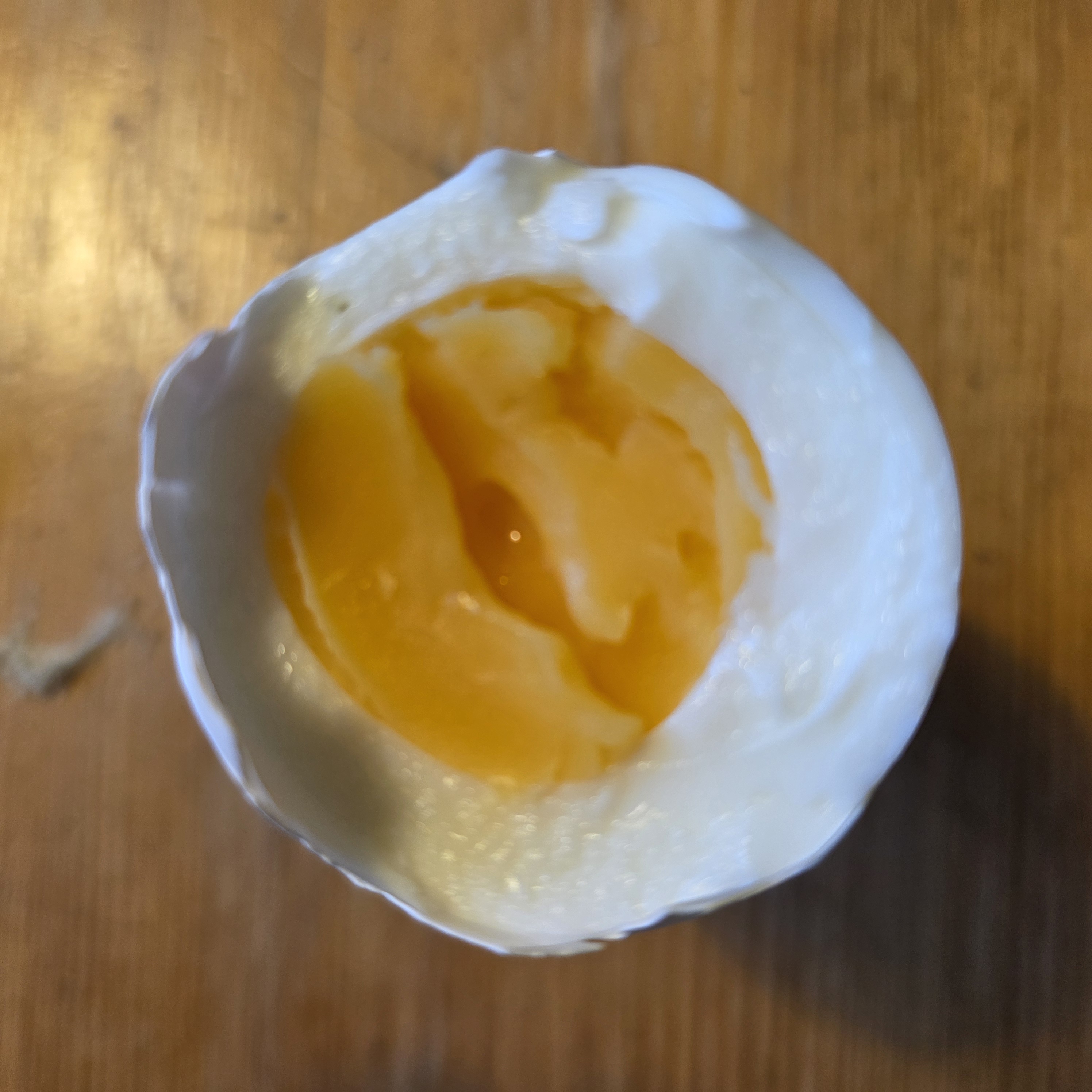 This time it worked out perfectly! I like the egg hard-boiled but still a little soft.
We prefer that eggs be from happy hens; that's important, of course. I check the package to see if the eggs are from happy hens. You don't want the eggs to be contaminated by PFAS. Or, as I used to think of it: You don't want the hens to be too happy, for example, roaming around outside. It may sound like a joke, but it has its basis in the soil around us.
In the Netherlands, the soil is covered in PFAS from Chemours, formerly DuPont, in Dordrecht. Anything downwind of Dordrecht is covered in highly poisonous PFAS chemicals. This includes our property in the Netherlands. PFAS climbs up the food chain. Rain worms pick up the poison and pass it to chickens. Indoor hens, by contrast, get PFAS-free food supplements.
Sweden has no factories producing PFAS, so the situation is more local. Around an airport, they probably tested the fire-protective PFAS foam daily by spraying a little into a nearby forest. That is how it has been done in many places in Europe. Who knows, do they still do that? For the rest, only factories that apply PFAS to products have been releasing the chemical.
The rain stopped, we finished our PFAS-free breakfast, and we went out to undress the tractor. 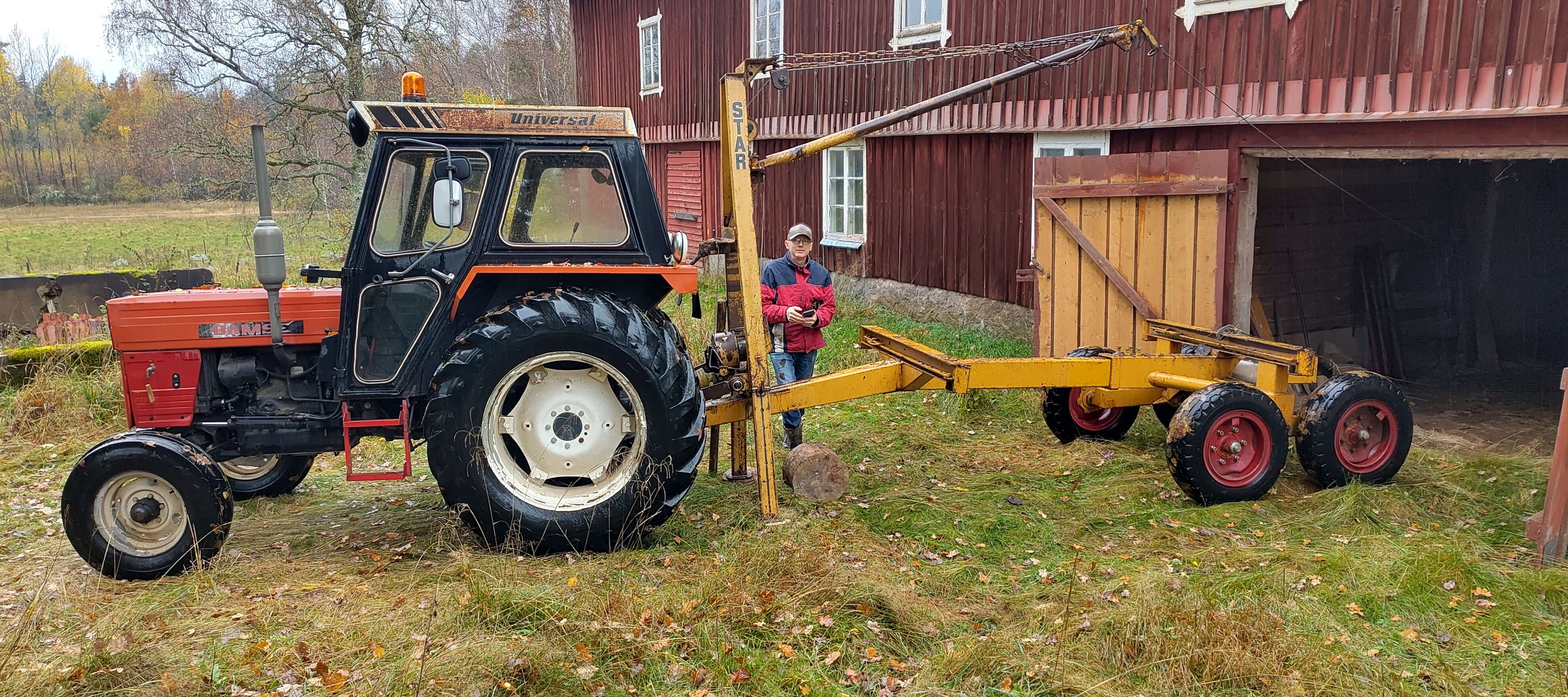 It is a simple principle; we do everything in reverse from last Monday. There are a couple of differences. Here, I connected the crane wire to a hook in the back wall of the barn, then ran it back to the wagon via the pulley. I set up the hook a couple of years back, but I never blogged about it. DW was surprised I had put it there and liked seeing the wagon be pulled into its place without us needing to push it. It was a small triumph that it worked so well.
I adjusted the spring between the tractor's arms just nicely. These small adjustments make the process simpler every time. I wouldn't be surprised if I put a printout of a QR code inside the barn, linking to last week's blog, with the steps I need to take to dress the tractor again without hiccups. That's typical Jens, because everything is a process. Once documented, the process can always be improved gradually.
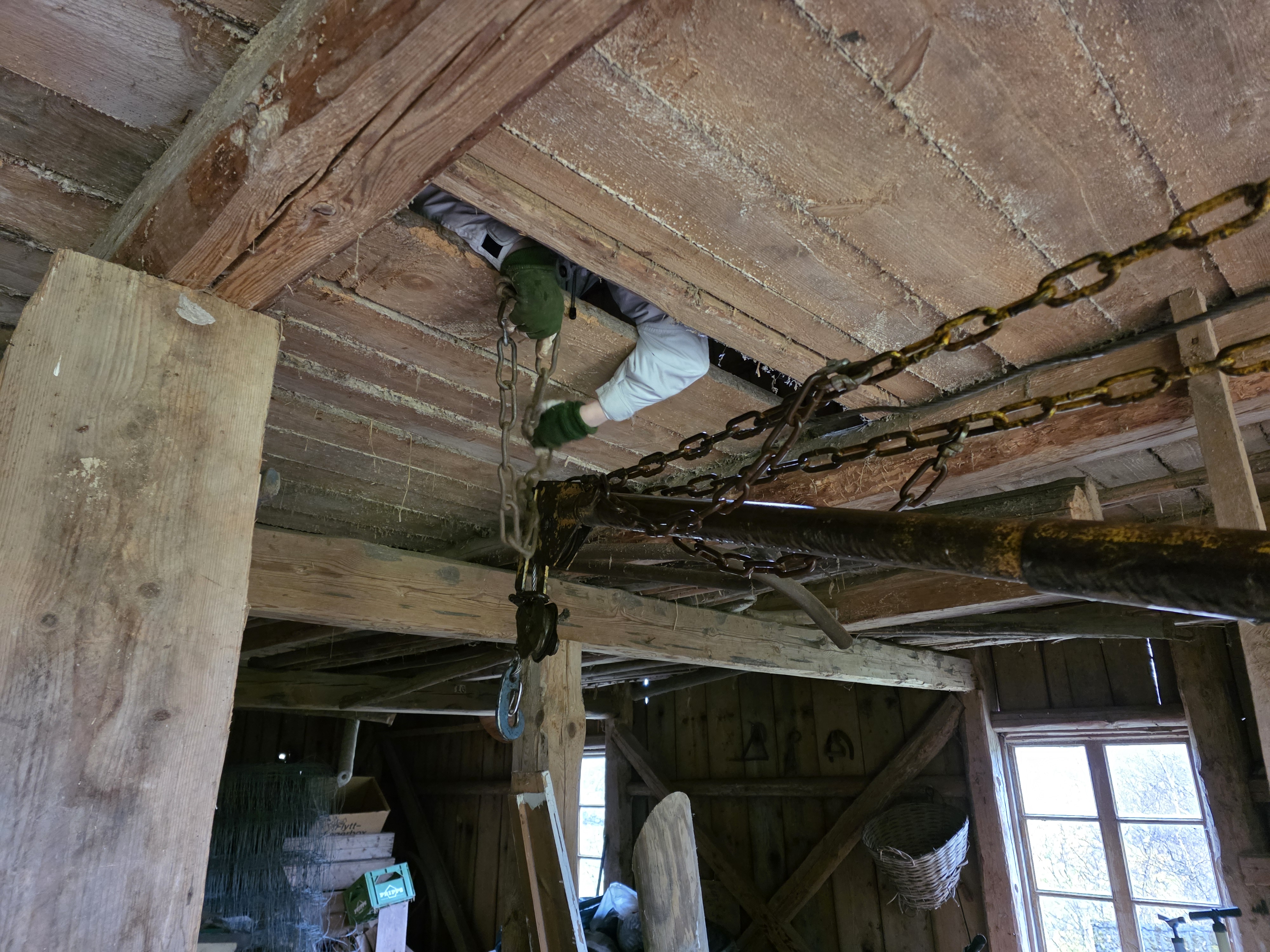 When the wagon was done, we put the crane in its storage place. In this photo, DW hooks the crane arm to a chain so it will not fall forward when disconnected from the tractor.
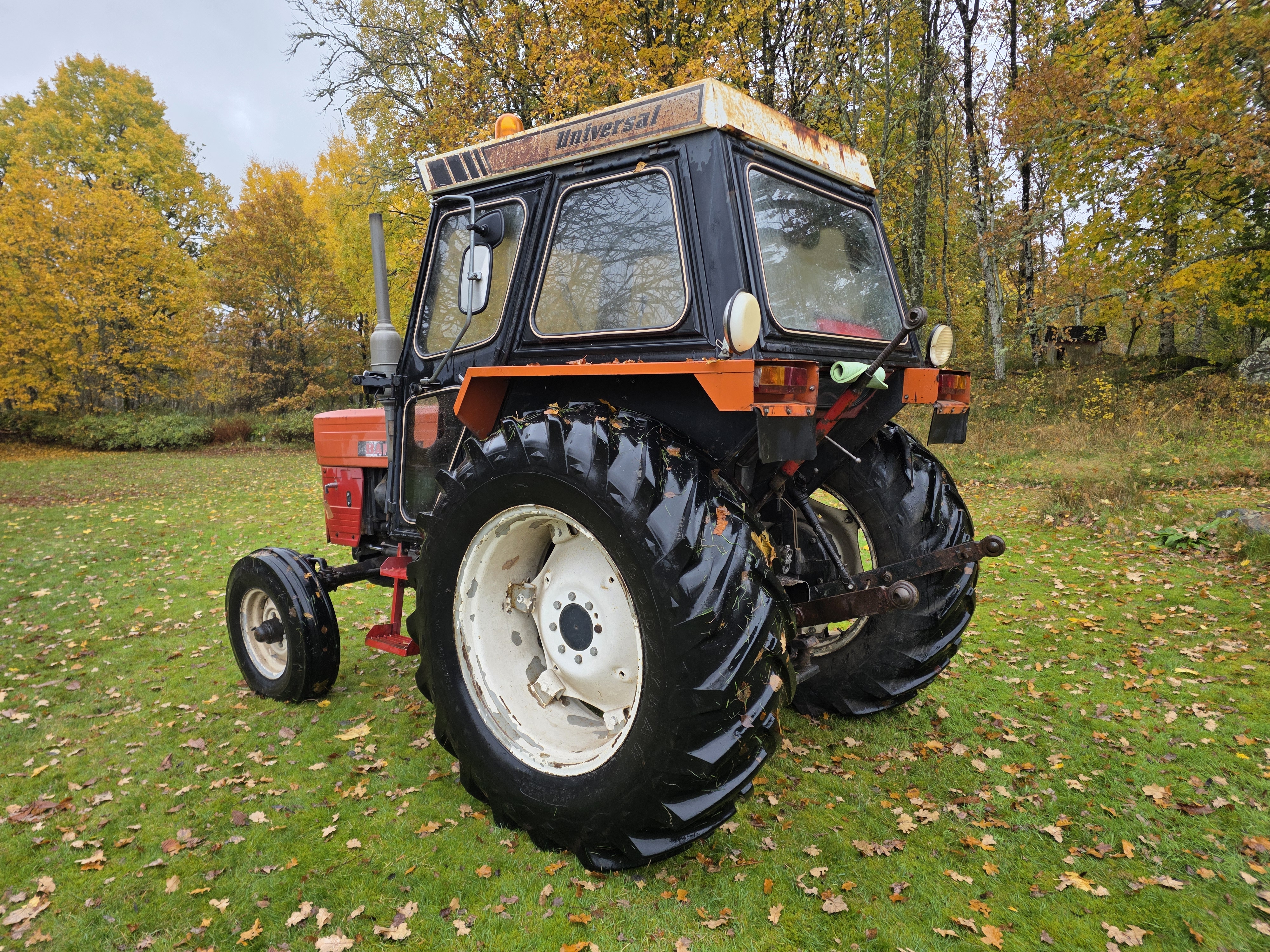 Here is the tractor properly undressed from the crane and wagon. Ready to go into its own garage. It looks so small and insignificant in this photo, but it's a beast in its own right.
Now the tractor was done. I could relax and do absolutely nothing, or could I? I went out behind the barn with the plasma cutter. The last time I used the plasma cutter was on 24 March. That time, I talked about losing the plasma cutter's extra nozzles and then finding them again. Well, the nozzles are completely gone now. I worked my way through the top lid of the box until the nozzle was so worn out that it no longer worked. Then I switched to an angle grinder for the last couple of inches. It had become so dark that I used an extra lamp to see the working area. DW told me she had been out in the dark to check on my status. She said I had been sitting there, cutting and banging a hammer against the metal box. I wanted to make some progress before calling off the project for the day, so I kept going, although I had promised DW beforehand that I would stop cutting when the sun went down.
Friday 23 October
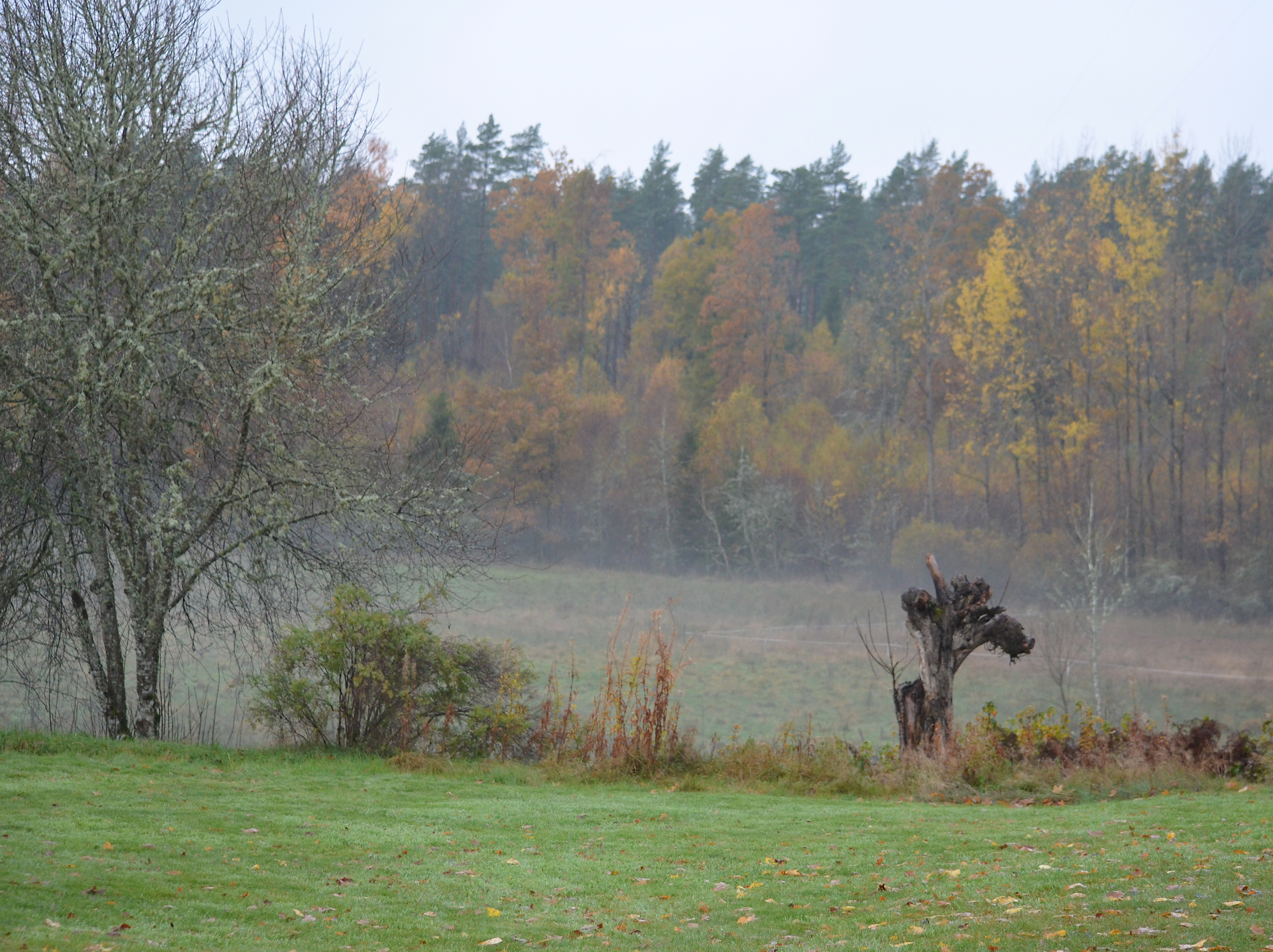 This morning was slow. A well-deserved slow morning; it is a holiday after all. It was misty.
After the tractor's battery hiccup earlier in the holiday, the neighbor André said it is better to store the battery above freezing when it's not in use for a long time. Today we unscrewed the battery and placed it on the kitchen bench. In the kitchen, we keep the temperature at a minimum of 10°C.
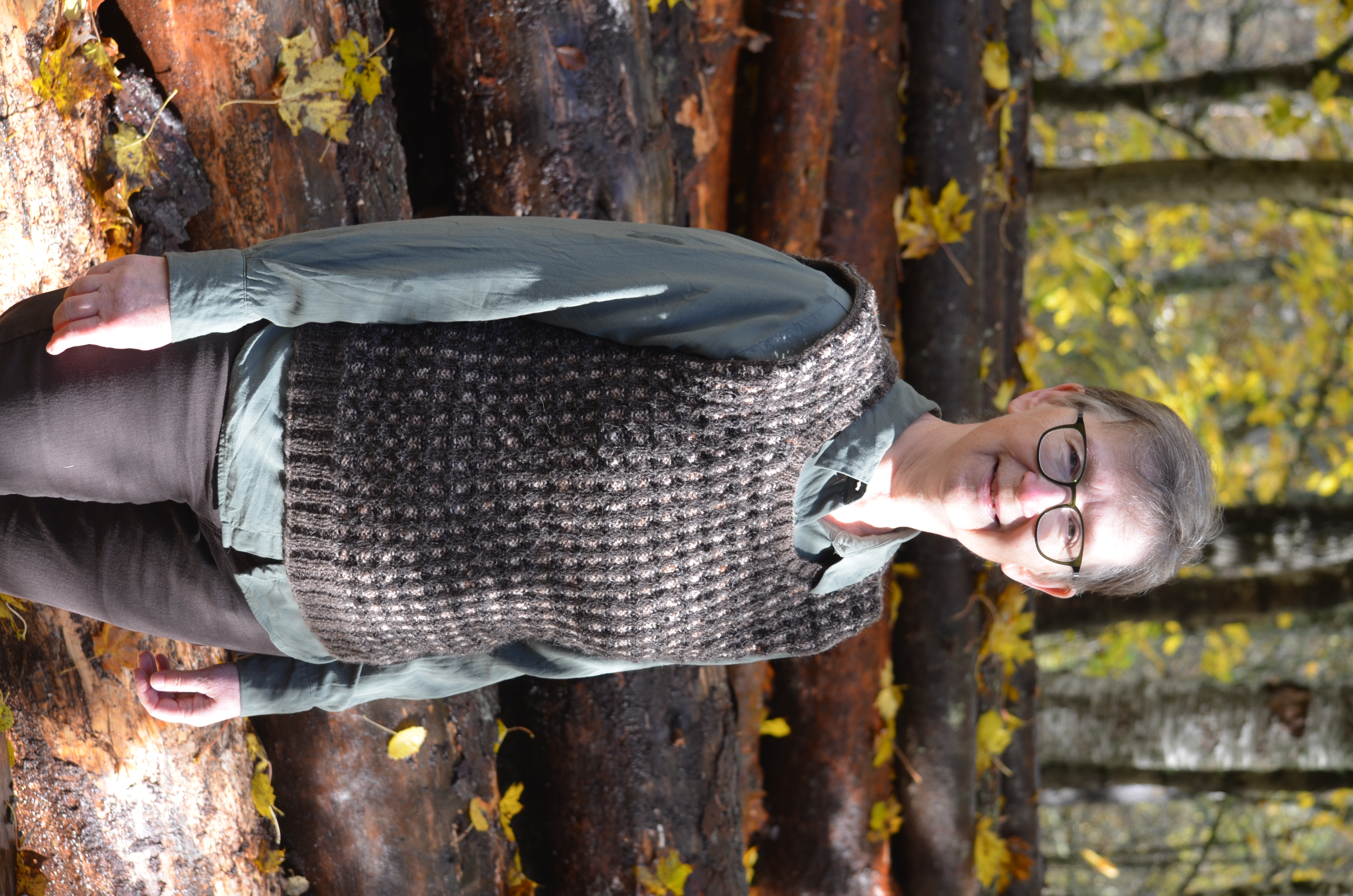 DW had finished her "Martall" vest from the book The Island and the Forest. She wanted pictures of her vest so she could blog about it. Droplets fell from the trees, even onto our necks! In this photo, she is standing in front of the pile of logs we have been hauling this holiday.
In the afternoon, we had the last golden hour of this holiday at the cottage. I have rarely seen a golden hour so close to pure gold! A storm is approaching this weekend, so the leaves will be flying through the air.
|
|
|
|
|
|
|
|
|
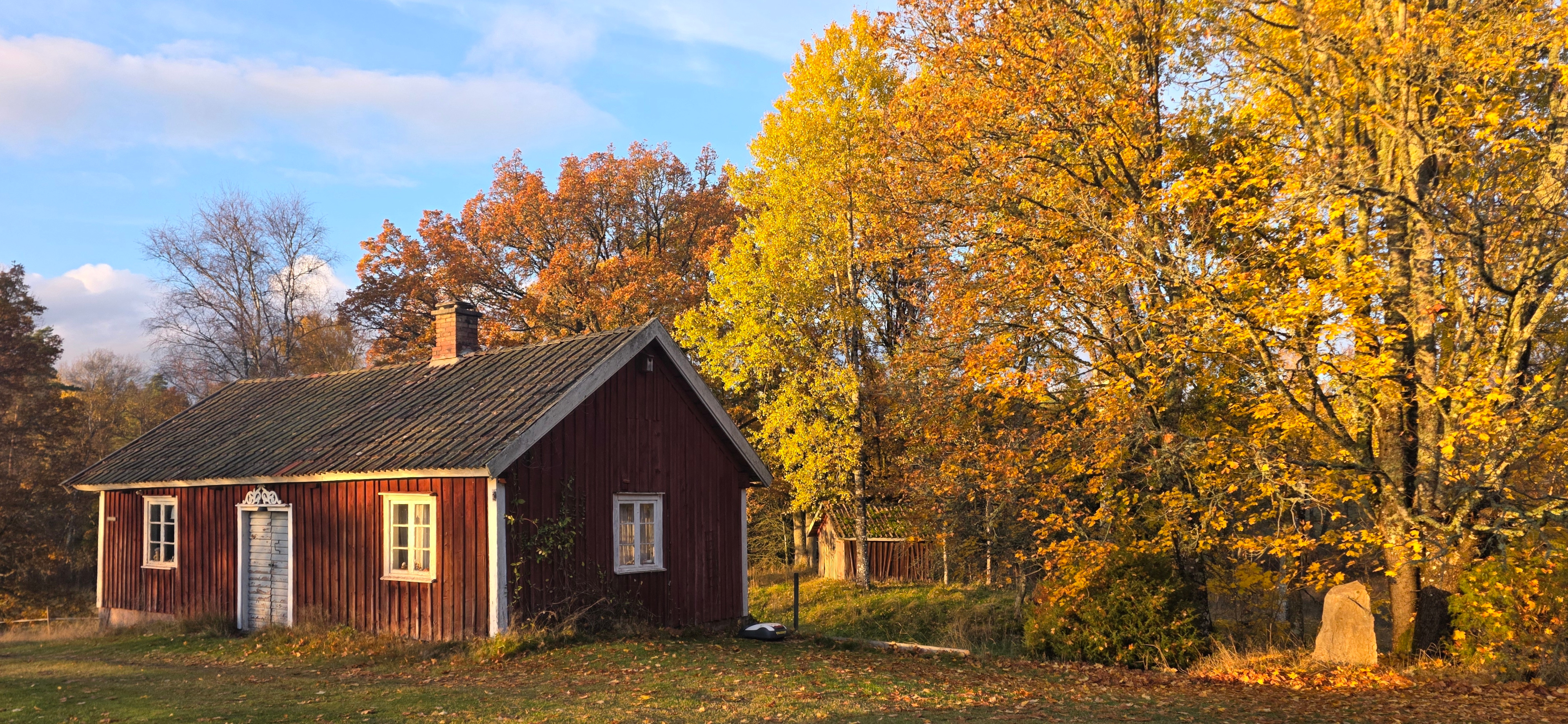
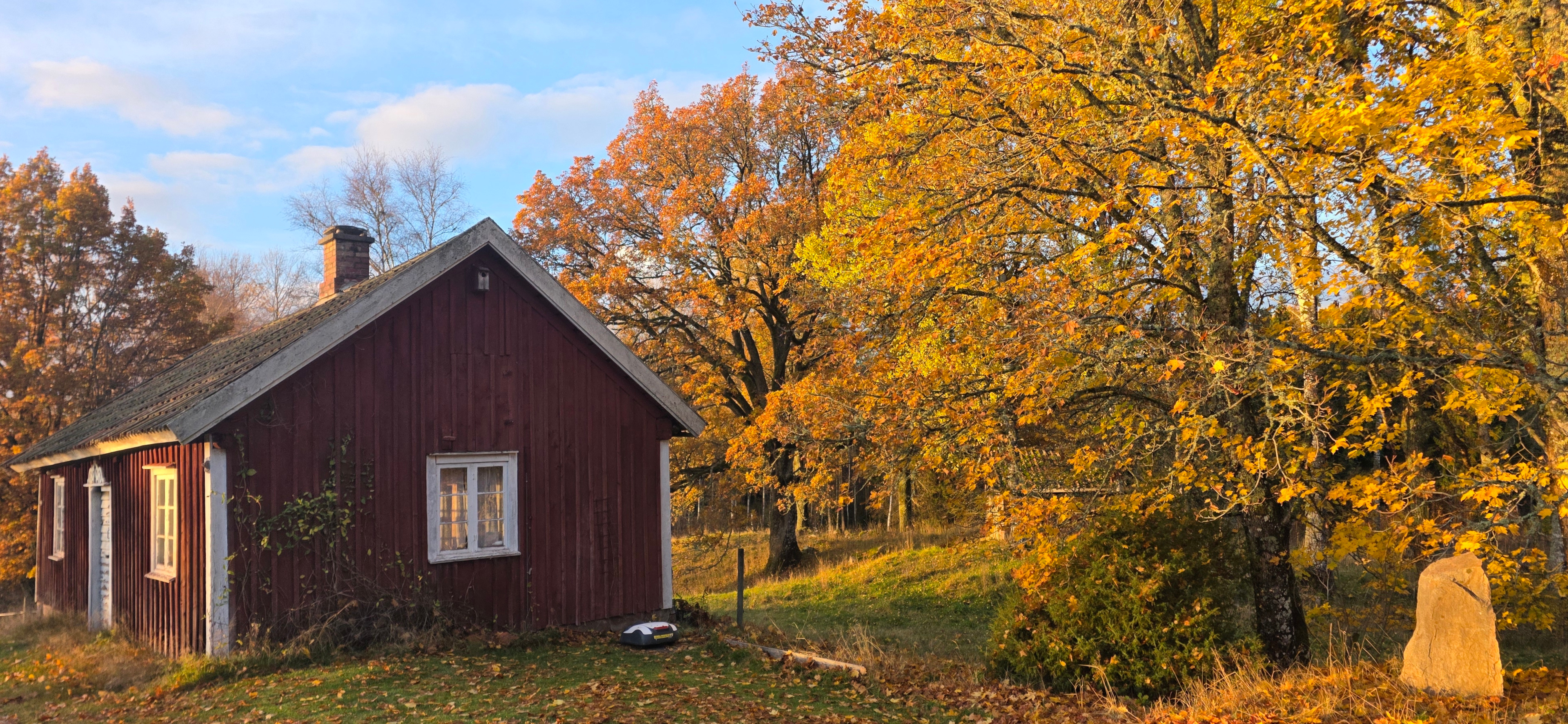
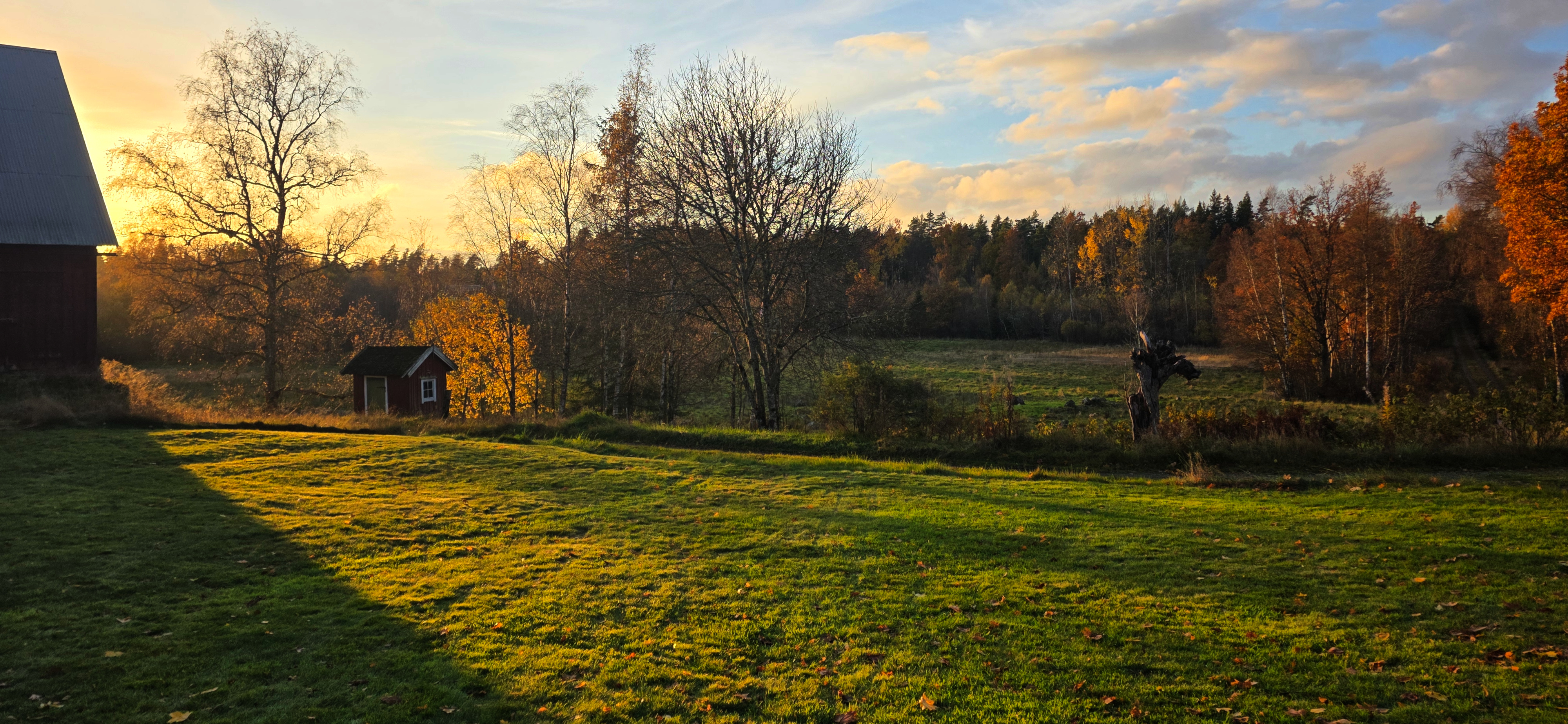
In the evening, both DW and I blogged. It was nice! I removed the telecom tower from the image. It is a little cheating, but it makes it look better.
DW had issues with the Blogger editor. It was awful; images jumped around for no clear reason. I failed to help her with the Blogger editor. It was not easy. At some point it was okay-ish. She published the blog at www.silverluren.se. She doesn't have an SSL certificate, so the browser flags it as insecure, but it is perfectly fine!
Saturday 24 October
Today's action plan was simple: clean up the cottage and drive toward the Netherlands.
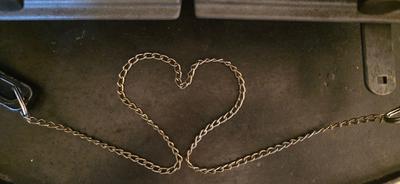
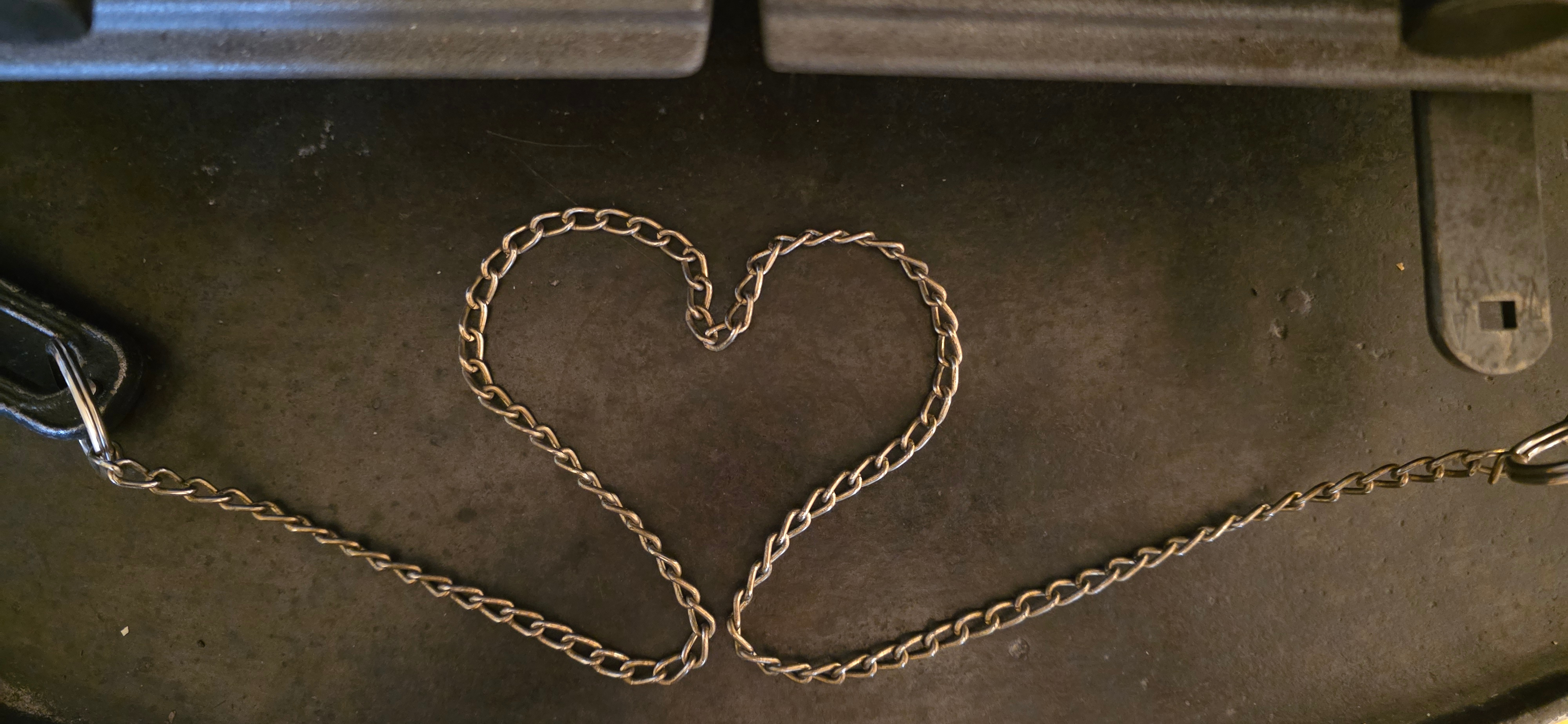 I cleaned out the living room woodstove. The woodstove door handle is connected to a thin chain. I arranged the chain in a heart shape for the next visitor to the cottage. I think it will be my sister.
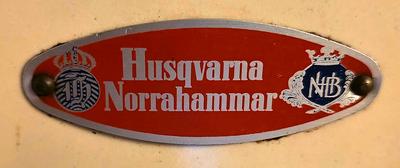
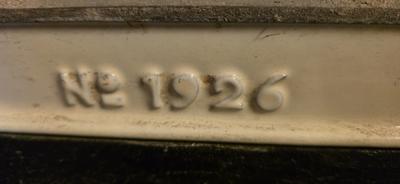
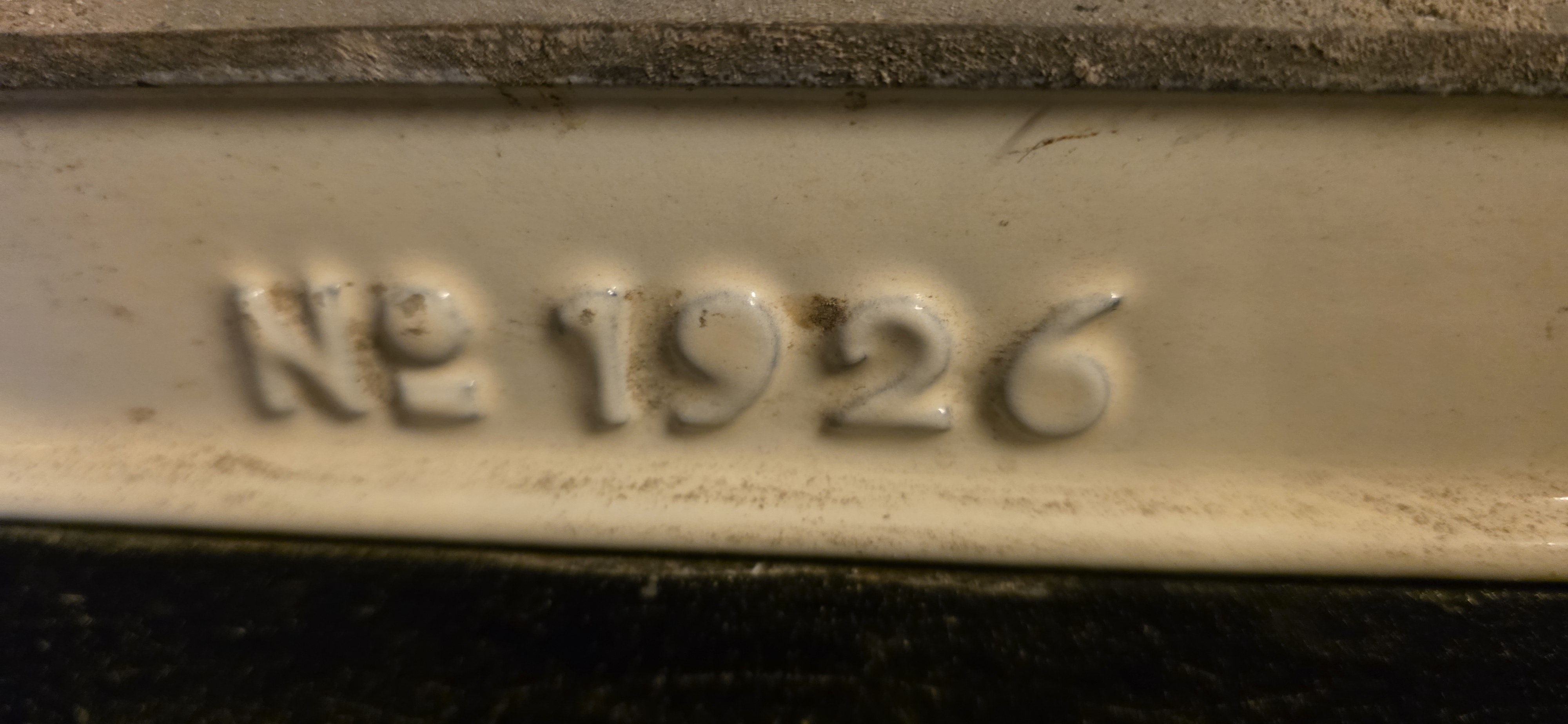 While cleaning the woodstove in the kitchen, I noticed it was produced in 1926! That means it is one hundred years old. I congratulated the stove on its birthday.
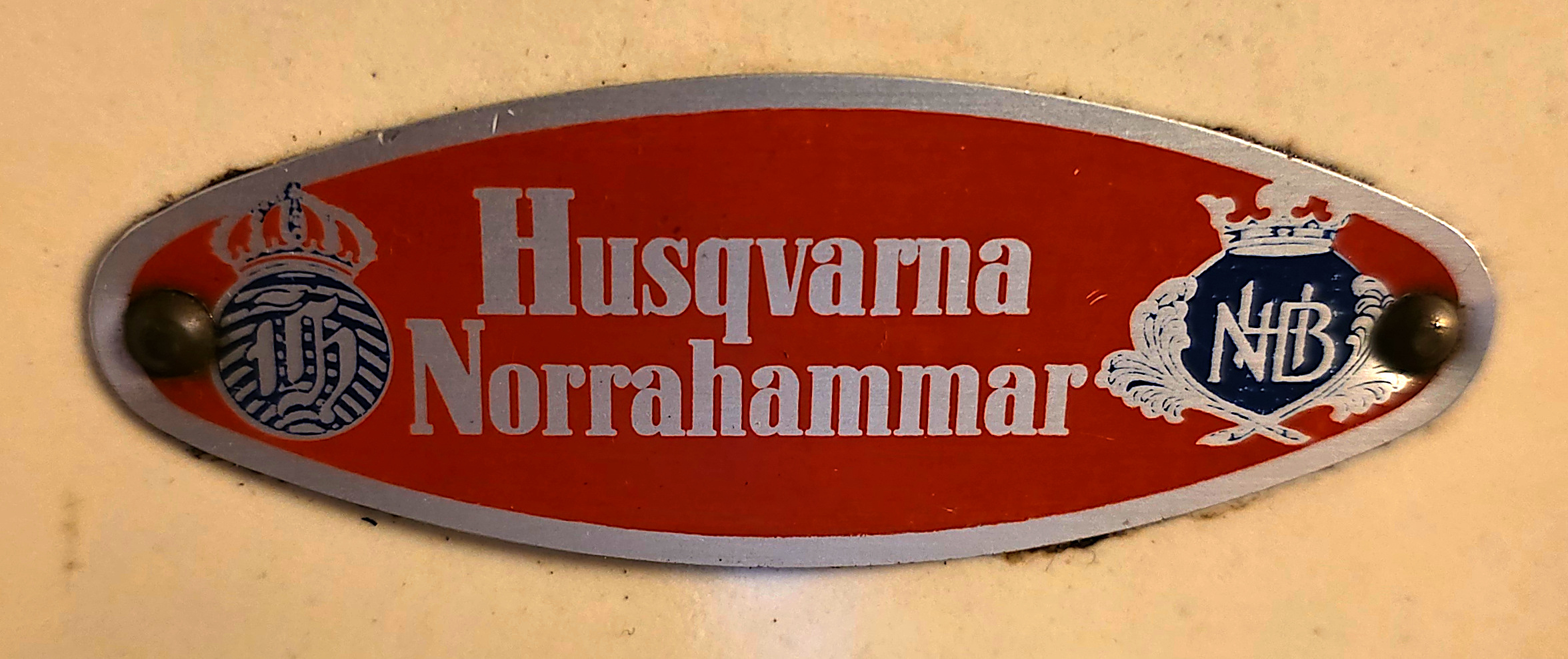 It is a Husqvarna Norrrahammar woodstove produced from 1926 onward. The stove's water tank is leaking. It is something we could fix "relatively" easily. You lift off the top of the stove, remove the tank, and take it to someone who can solder it. That sounds like a project for another holiday!
We cleaned the cottage and packed the car. In the early afternoon, we left. I took a photo of the cottage similar to the photo I took when we arrived.
|
|
|
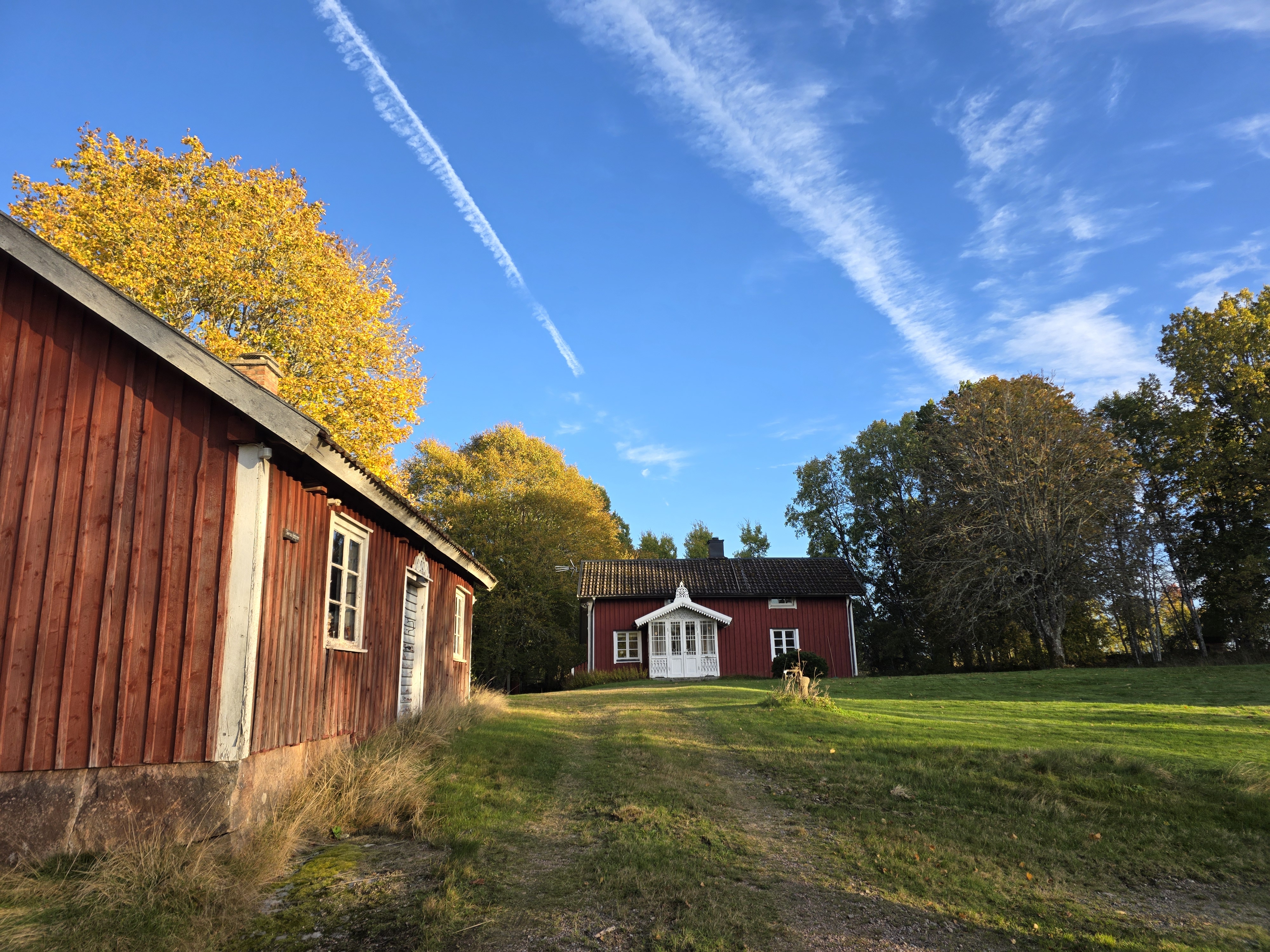
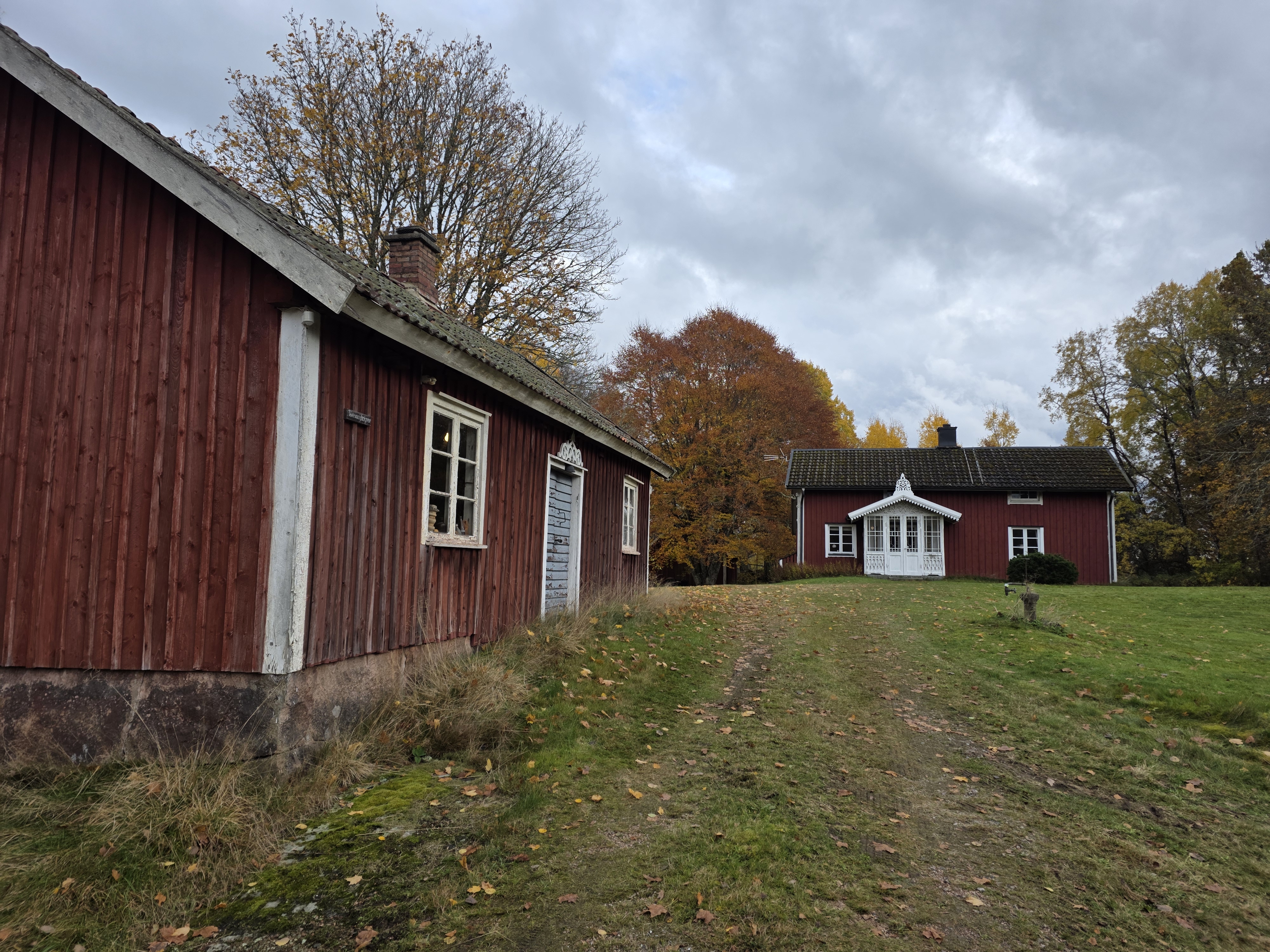
We did not go straight to the motorway. First, we stopped at the same hardware store where we bought the plasma cutter on 17 March. They did not have consumables for the plasma cutter. You had to order them, and they would arrive a week later; you had two weeks to pick them up. Oh, I live in the Netherlands? When I come home, I really need to find the cutter nozzles.
Then we started driving. It rained a lot, and it was windy, so it wasn't pleasant to drive. We stopped briefly in Malmö to fill up on gas. Then we continued driving to a hotel in Odense.
During this stretch, I noticed the engine started to misfire (buck or jerk) when I demanded power. One way to avoid the misfire was to shift down when I needed more power. It was dark, it was raining, and I really wasn't in the mood to stand by the road with a failing car. At first, I had a calm little internal freak-out. DW started searching for the cause, and we concluded it was probably the spark plugs or their cables.
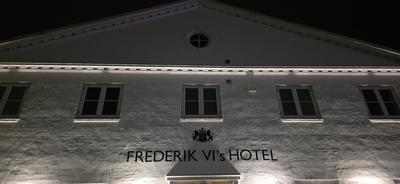
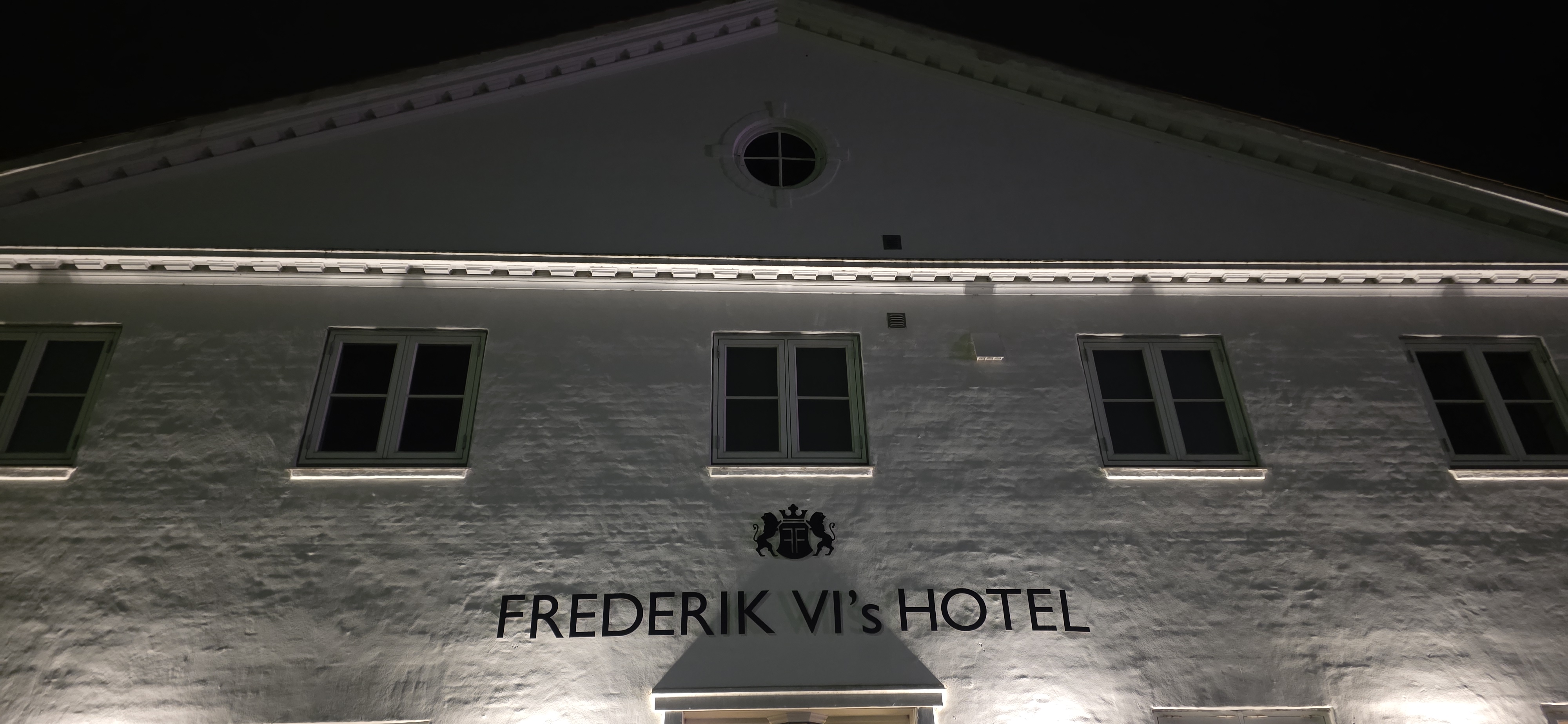 We arrived at our hotel in Odense. It was Frederik the 6th Hotel. We have never had a check-in that smoothly. DW said our name, and she received the room cards. All the paperwork was already done because she booked the room online. Until now, we always wondered why the hotel couldn't have all the details on file since they were already entered online. Apparently it can be done! Five stars for an efficient hotel.
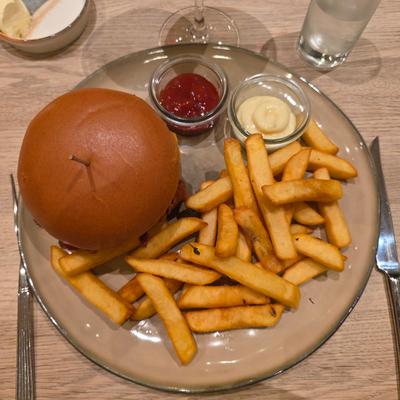
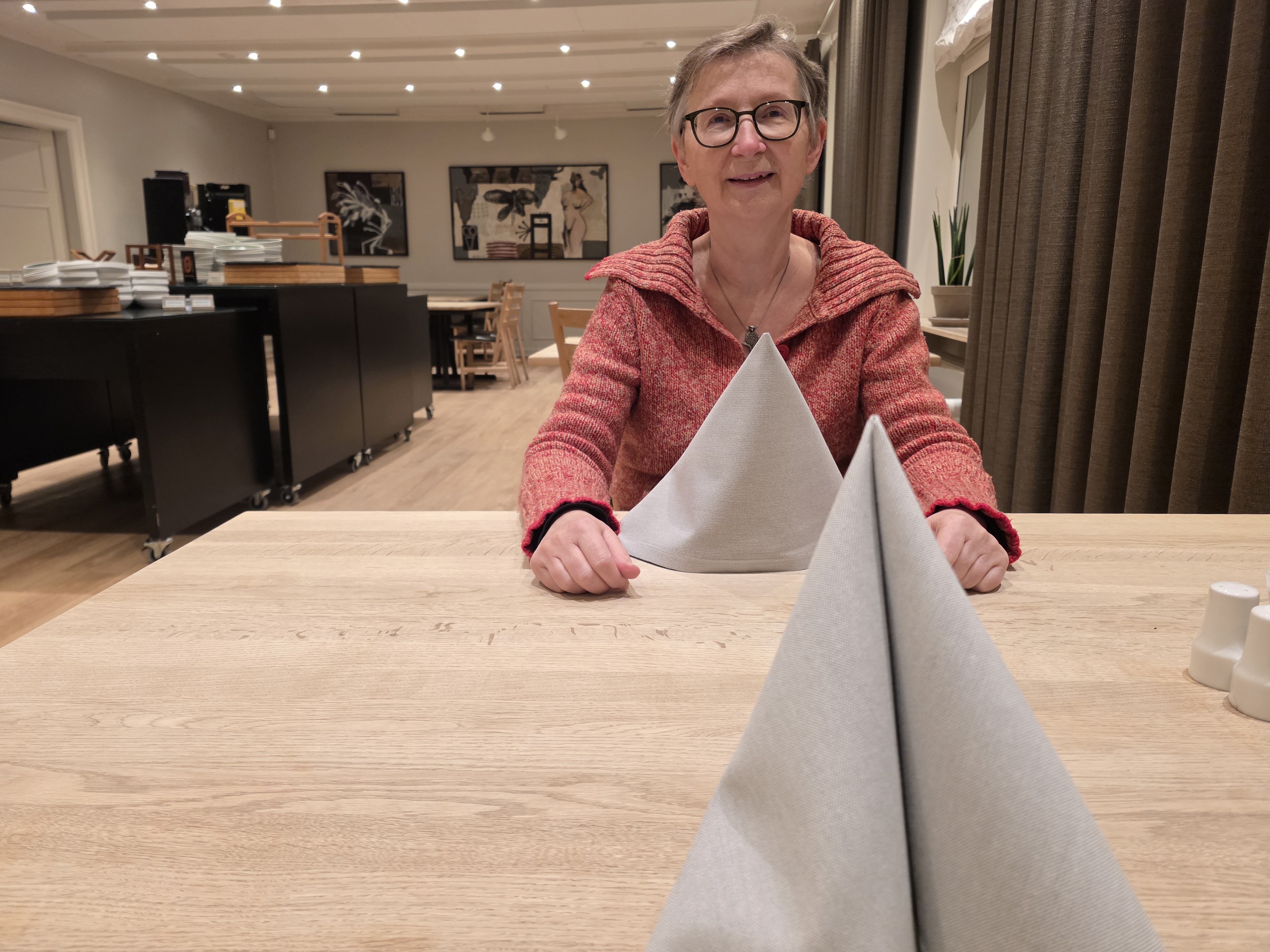 Next up, we asked if the restaurant was open. The hotel's restaurant was booked for a party, but they welcomed us into the breakfast restaurant in another room. Did we fancy a hamburger? DW had a vegetarian, and I had one with meat. What to drink, wine? Yes. I kid you not, that order was handled in less than 45 seconds.
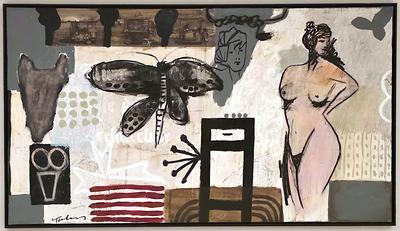
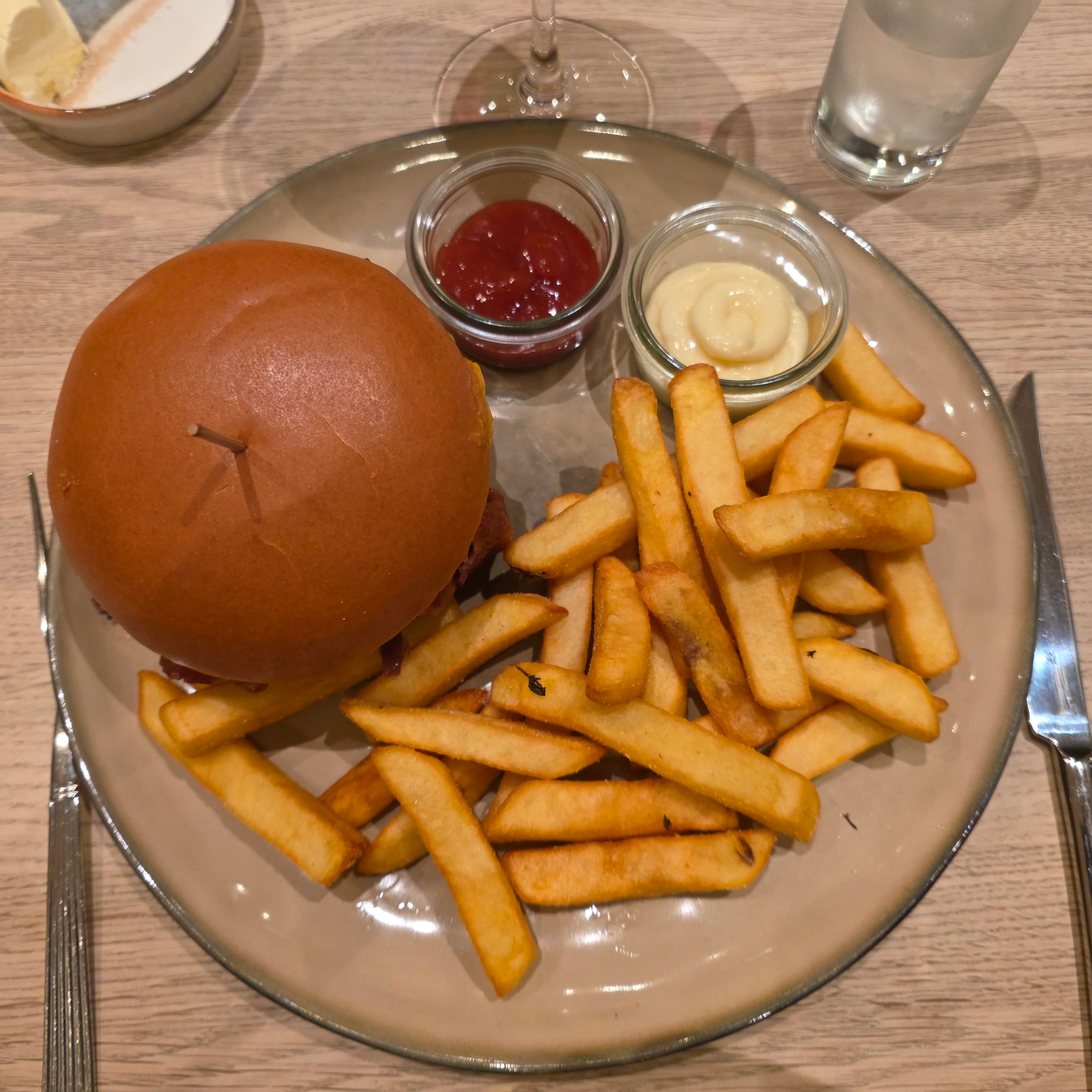 We sat in a room with nice paintings on the wall, and soon after, our dinner was served.
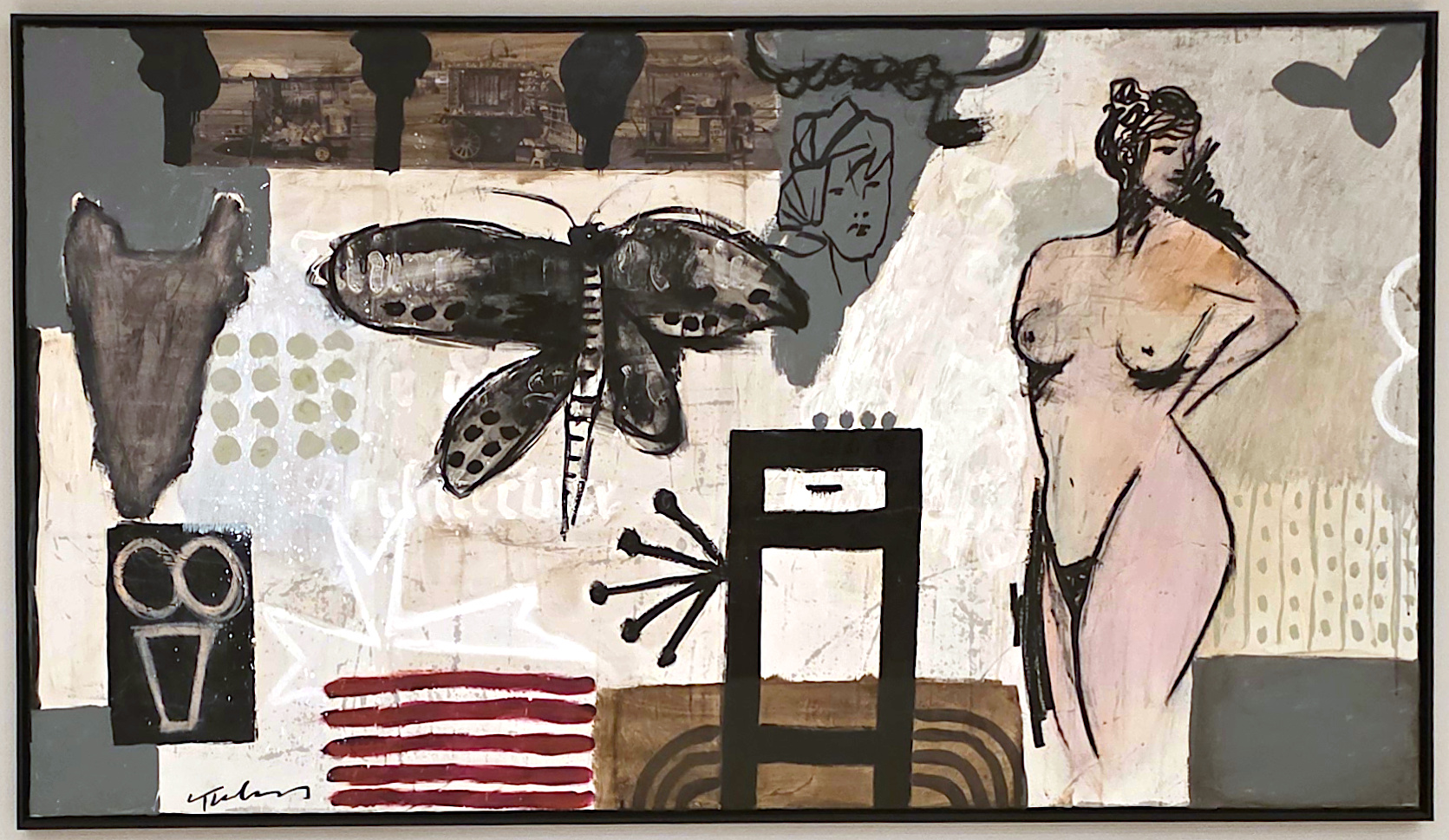 They had paintings of Kjeld Ulrich on the walls. I always appreciate it when the hotel decorates its walls with the work of real artists, no matter how famous they are. Isn't it fantastic to stay in a hotel and get a feel for the local art scene at the same time?
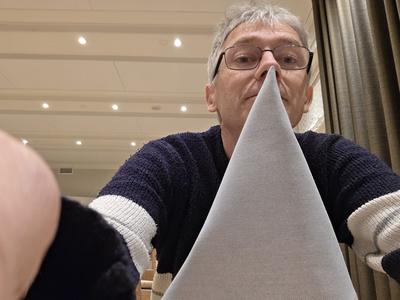
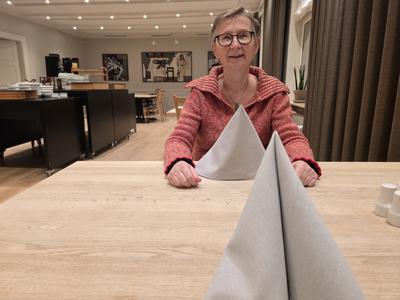
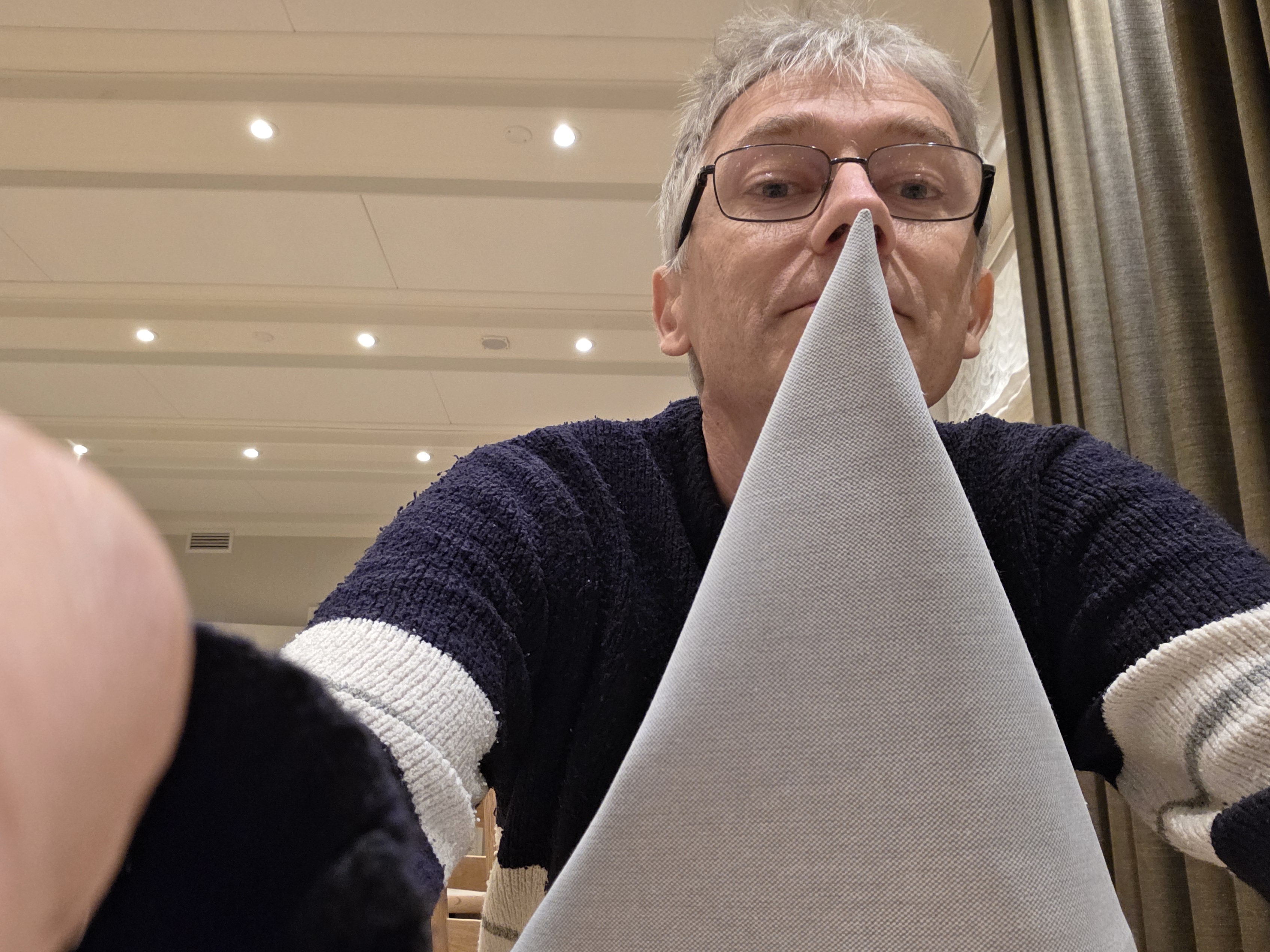 We were tired. I made a silly self-portrait. It is all a question of perspective. DW didn't like that I was trying to find out who painted the painting at the end of the breakfast room wall. The silly self-portrait, on the other hand, made her laugh!
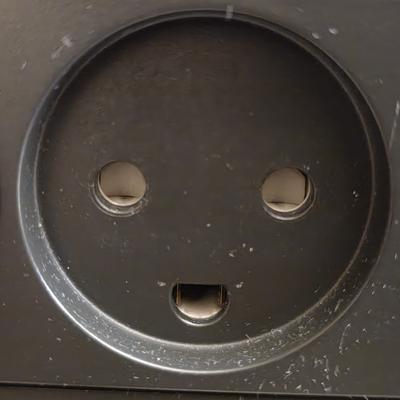
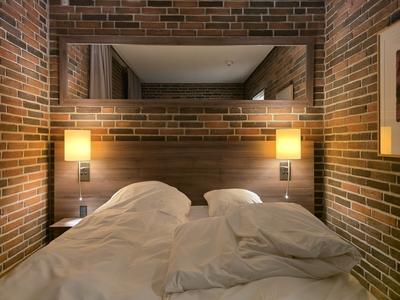
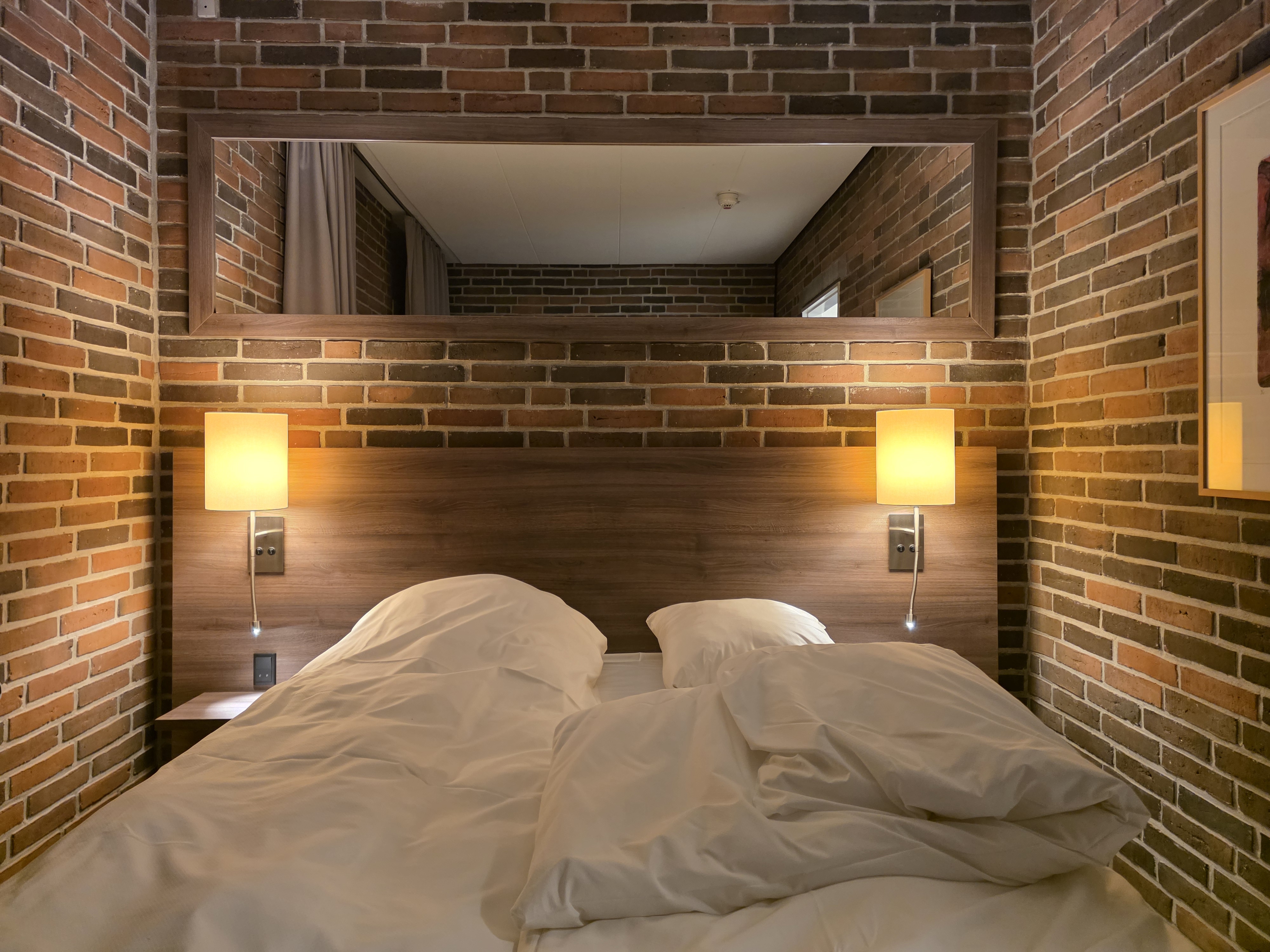 The room was modern, but it somehow had a 1970s tint. Could it be the bricks? One unusual thing about the room was the Danish power sockets. I realized the sockets were disguised as a two-hole plate.
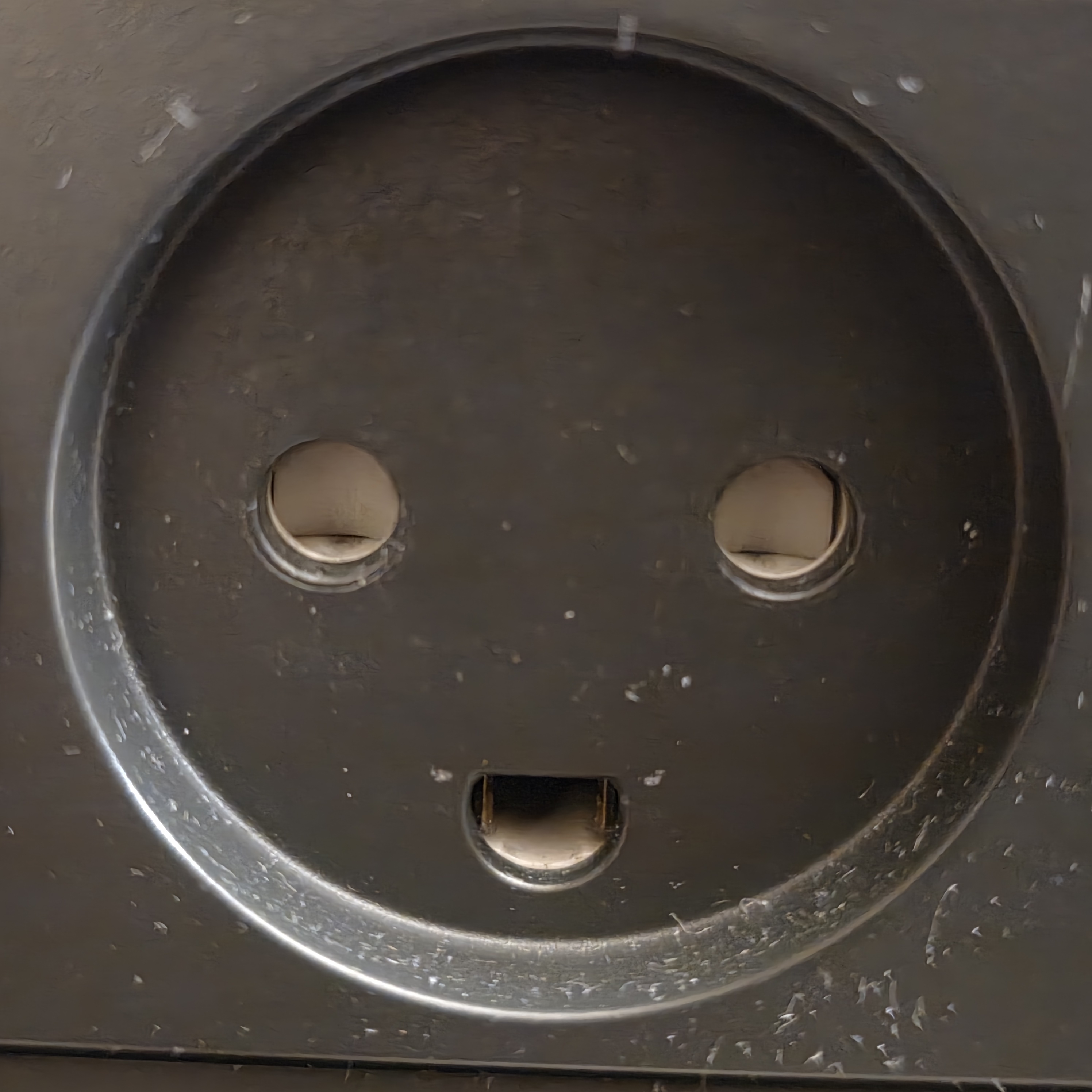 In Sweden and the Netherlands, the Schuko socket is unmistakable. In Denmark, it is a Danish 10A socket that looks like a smiley! How cute is that?
Sunday 25 October
Tonight we gained an hour because the clocks changed. As far as I'm concerned, we could stop changing the clocks altogether. I slept fine. I removed the thick duvet, and we opened the window to the hotel's inner yard. The only minor issue was a party in the hotel restaurant adjacent to the inner yard. The party didn't last long, but it went on long enough for us to wonder what kind of music they were playing. The best guess was drum and bass. I could not figure it out. The bed was not that wide, but it was okay.
The shower was fine; it had the soap screwed on to the wall. The water pressure was a little weak, but we could get used to it.
We went to the breakfast room again. Breakfast was included in the room rate. All guests could have breakfast. The benefit is that no administration is needed during breakfast. Everything in the hotel was efficient, so this was also well thought out.
The breakfast was zero waste. DW really appreciates it when they do that. Everything we expect to find at the breakfast buffet was available; it was nice.
We started driving, and we still had issues with the car. When I pushed the gas pedal too hard in too high a gear, the car started stuttering. We discussed whether the car would stop working properly after a certain amount of stuttering, but DW didn't think it would.
However, ignoring the stuttering triggered a warning system. Then the EPC warning light appeared on the dashboard, which stands for Electronic Power Control. At that point, the car couldn't accelerate as well anymore. I stopped at a gas station and filled up, even though I had enough gas. I calmed down a little. We had only one goal: get home today. If I could drive home calmly, without any EPC warnings and with fewer stuttering events, we could get home.
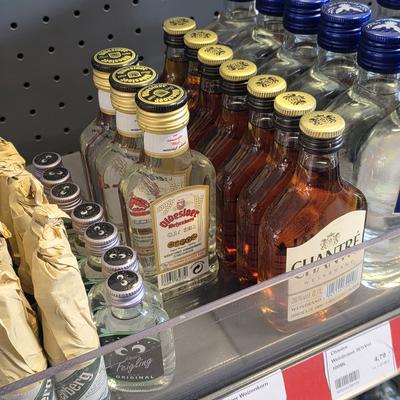
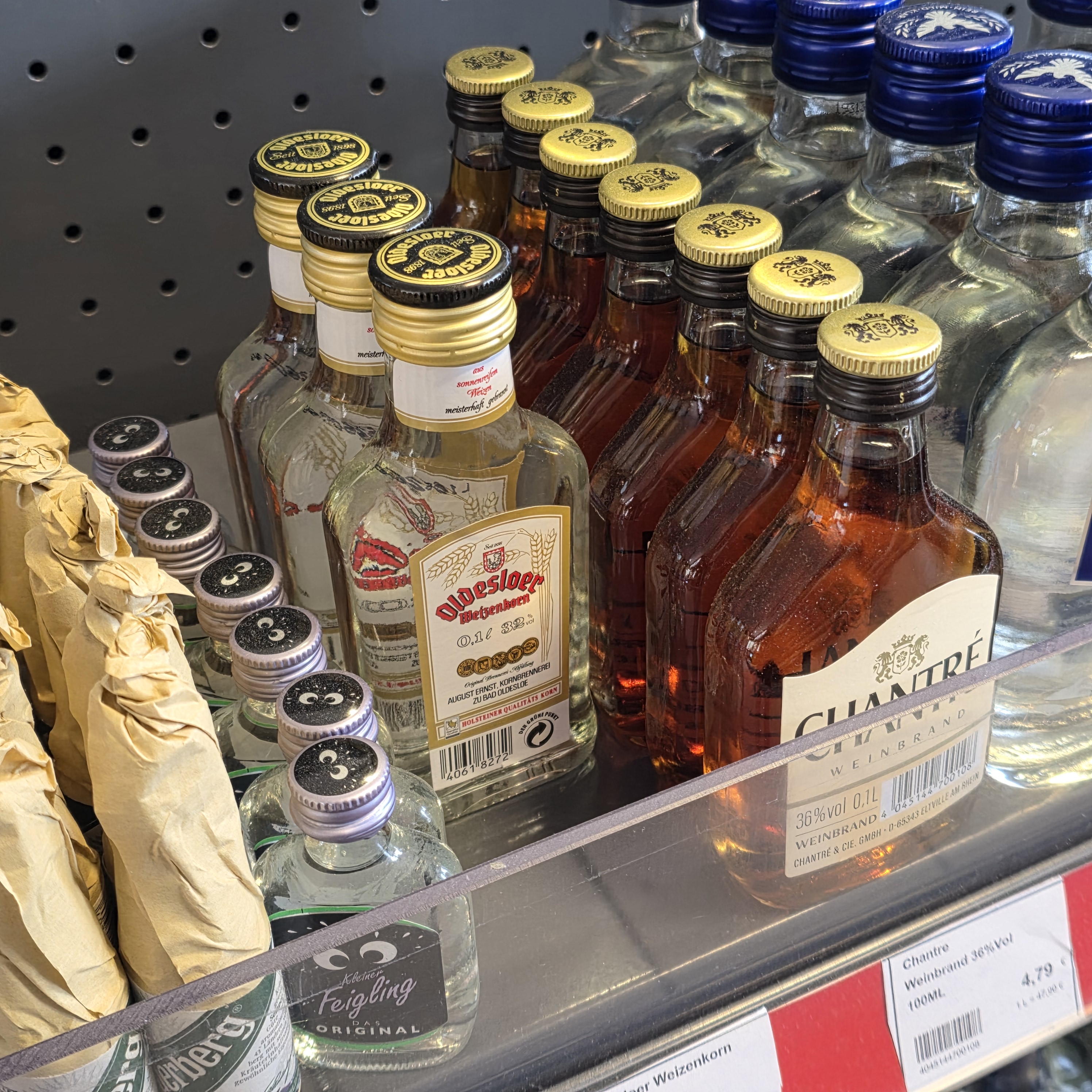 At the Quickborn gas station, I noticed a funny product display. High-percentage alcohol drinks. You wouldn't find anything like that in Sweden. After the gas station, it was like someone had read my mind. A large sign beside the road read in pure English: Don't drink and drive. It was not in German. Clearly addressing all but German users of the Autobahn. How funny is that!
It was annoying to be stuck behind slow cars. On one of the free-speed stretches where I could have been driving at the car's maximum speed, I got stuck behind a lady with a funny hat driving a luxurious Porsche at a modest speed. The car could sustain higher speeds, but it wasn't good at accelerating, which is what you need to overtake another car. As the day went on, it became instinct to downshift on hills, when overtaking, etc.
A Dutch saying is: Driving as if you had an egg under your gas pedal.
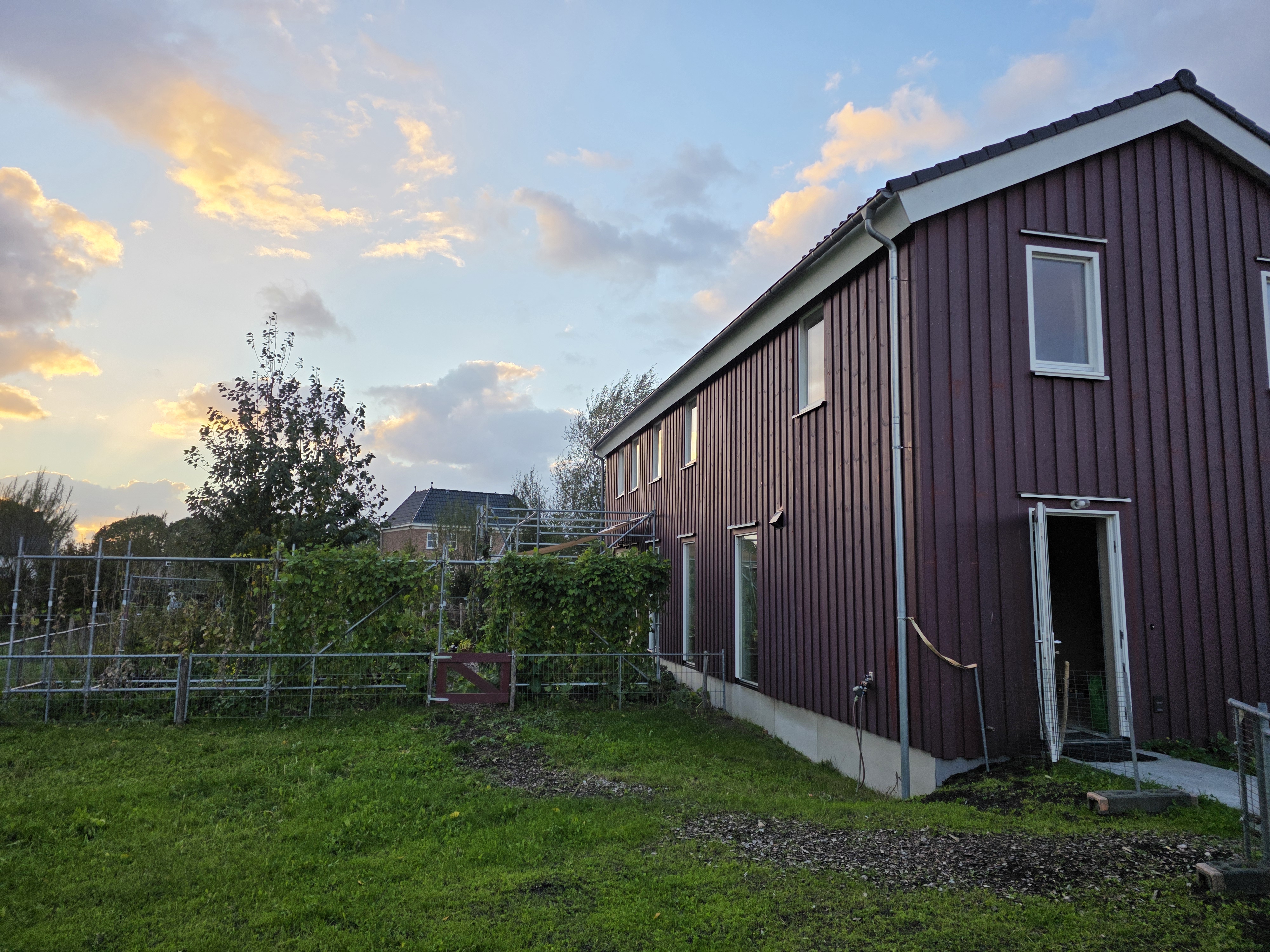 We arrived at home at 5 PM. It was nice to meet DS, Merida, and the sheep again.
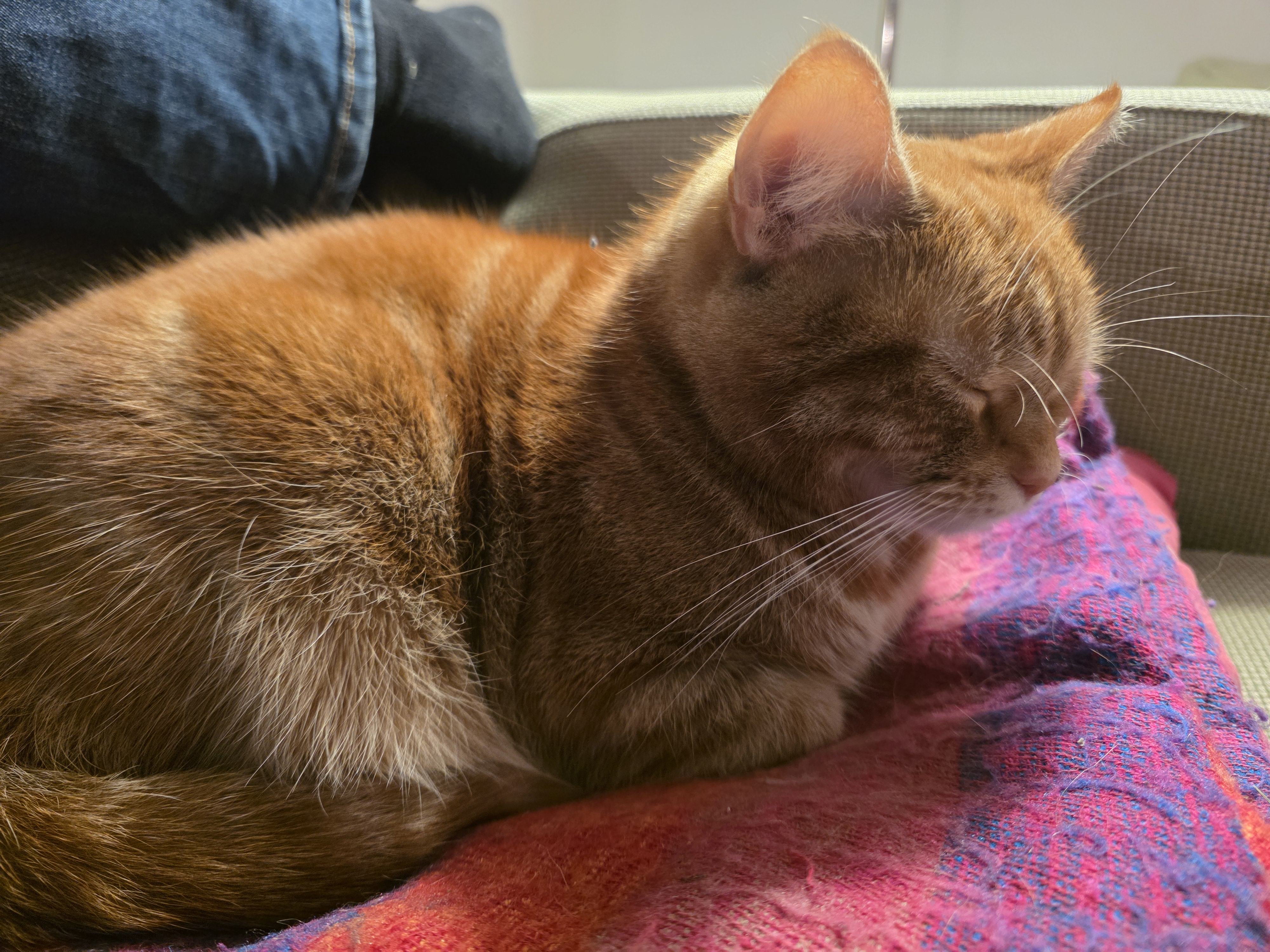 Merida wasn't that happy about our absence, but she definitely approved of our coming home.
Here ends this week's blog. Next week, I would like to have the car fixed. That is for sure. I wrote 4300 words this week. Welcome back next week for a new blog episode.
Here is an in-depth analysis of the blog made with Google Notebook LM.
 Heavyweight MikadoThe eye-rhinoA week at the cottageIs this the end of spectacular sunrises?Finished the roof of the wood-store houseGot all roofboards mounted!Replacing the roof of the wood-store house at our cottage in SwedenRenovation of root cellar roofMounted the winchFetched planksStayed at our CottageRepaired the washing machineCottage improvementsFront porch ornamentPainting the ceiling in the cottage
Jens Malmgren, A Swede in the Netherlands.
Software engineer, tinkerer, gardener, violinist, painter. Producer, DJ, parent, cat and sheep owner.
I write this weekly personal blog about life in the Netherlands and at the cottage in Sweden.
I create.